Lecturer (Assistant Professor) in HRM & Future of Work, University of Bristol Giorgos Gouzoulis is a Lecturer (Assistant Professor) in HRM & Future of Work at the University of Bristol, School of Management since 2021. His research focuses on how globalisation and financialisation affect wage bargaining, workforce casualisation, and industrial conflict, focusing on advanced and emerging economies. His work has appeared in world-leading academic journals, including the British Journal of Industrial Relations, Economic and Industrial Democracy, the Industrial Relations Journal, the Socio-Economic Review, and Sociology of Health & Illness, among others. Also, Giorgos is a member of the editorial board of Work, Employment and Society.
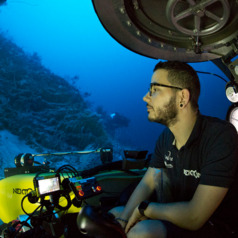
Senior Postdoctoral Researcher, University of Oxford I am a marine biologist fascinated by the largest environment on planet Earth: the oceans. My general research interests lie in documenting the distribution patterns of marine life in the oceans and identifying the underlying environmental factors shaping those. Part of my research portfolio has included biodiversity assessments of ultra-deep underwater mountains in the NE Atlantic, shallow and deep water reef biodiversity in Bermuda, conservation of threatened species and plastic pollution in the Thames Estuary. At present, I am a postdoctoral researcher of the Marine Ecology and Conservation Group at the Department of Zoology, working closely with the NGO Nekton. My main research focus lies in assessing biodiversity and faunal connectivity across depth and geography in tropical reef ecosystems, and assess the impact of human activities on them. For that, I am participating in a series of Missions in the Indian Ocean led by Nekton, known as First Descent: Indian Ocean 2019-2022.
Global Journalism Fellow, University of Toronto Norma Hilton is an independent journalist covering everything from murder suicides to K-pop. She is a Global Journalism fellow and Investigative Journalism Bureau reporter at the University of Toronto.
PhD student, University of Adelaide Ana came back to university because she had too many questions on animal behaviour, and not enough answers. She is particularly passionate about helping dogs and humans live together successfully, through education, understanding, and researching the human/canine experience. In 2019 Ana published her honours research on sales of dogs on gumtree and is currently a PhD candidate at the University of Adelaide. Her current research centers on understanding puppy owners and their experiences, as well as researching the recently discovered effect of the “puppy blues”. Ana has a background working with dogs who suffer from anxiety disorders and is a graduate of the Delta Institute. She currently lives with a special needs little dog, “Nervous Nina”. For more information see: https://researchers.adelaide.edu.au/profile/ana.goncalvescosta
Tutor, The University of Queensland Martine Kropkowski teaches professional and creative writing with the writing team at The University of Queensland. She is also a HDR candidate researching the role that language and community-generated narratives play in coercing and controlling members of cult-like organisations.
Senior Beamline Scientist - Powder Diffraction, Australian Nuclear Science and Technology Organisation Helen is a beamline scientist at the Australian Synchrotron. She supports users from many fields of science to carry out experiments to investigate the structure of materials. Helen is a Planetary Geologist by training. She started her research career by investigating how the crystal structure of planetary materials can influence the geology that we see on the surface of icy moons in the outer Solar System. Subsequently, she investigated how minerals grow on Mars with CSIRO before joining the Synchrotron. In the last few years Helen has been able to diversify her research. This has included collecting meteorites in the Nullarbor and developing new analysis methods using the synchrotron to unlock the secrets of the early solar system, as well as helping identify pigments in some of the oldest Aboriginal rock art.