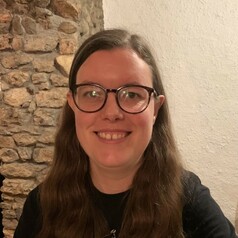
Honorary Research Fellow, Cardiff University I am an archaeologist specialising in the prehistory of Britain and Ireland. I trained as an archaeologist at Cardiff University, completing my PhD at the university, focusing on the rock art of the Neolithic passage tombs of Newgrange, Knowth and Dowth in Co. Meath, Ireland, and then broadening my research interests to include the subject of worldview; studying shamanism, totemism and animism. As part of my PhD in 2008, my research took me to South America, where I worked closely with the Shipibo tribe, the indigenous people along the Ucayali River in the Amazon rainforest in Peru. My rock art research took me to Namibia in 2017, when I worked with the archaeology department at the University of Namibia, Windhoek. I joined Cadw in 2011, the historic environment service for the Welsh Government, to work as a community archaeologist in the south Wales area. Currently, I oversee the public programmes for Cadw, across 130 sites in Wales. I co-direct a public archaeology project in the multi-period landscape around the important site of Bryn Celli Ddu Neolithic passage tomb, on the island of Anglesey.
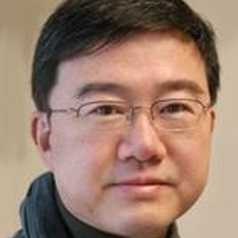
Professor of Sociology, University of California, Irvine Feng Wang in an expert on Chinese demographics and professor of sociology at University of California, Irvine. His research interests: include comparative demographic, economic, and social processes; social inequality in state socialisms and contemporary Chinese society.
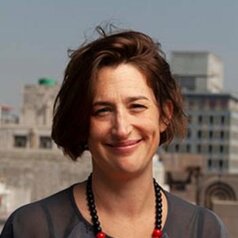
Associate Professor of History, Director of the Center for African Studies, Stanford University Joel Cabrita is a historian of modern Southern Africa who focuses on Eswatini (formerly Swaziland) and South Africa. Her most recent book is Written Out: The Silencing of Regina Gelana Twala (Ohio University Press, 2023). Twala was an unjustly neglected Black African literary figure in apartheid South Africa and colonial Swaziland (now Eswatini). The book shows that her posthumous obscurity has been no accident, charting how white scholars and politicians used racial and gendered prejudices to erase Twala’s work and claim her uncompensated intellectual labor for themselves. Cabrita's other publications include The People’s Zion: Southern Africa, the United States and a Transatlantic Faith-Healing Movement (Harvard University Press, 2018) which investigates the convergence of evangelical piety, transnational networks and the rise of industrialized societies in both Southern Africa and North America. The People's Zion was awarded the American Society of Church History's Albert C Outler Prize for 2019 https://churchhistory.org/grants-and-awards/ She is also the co-editor of a volume examining the global dimensions of Christian practice, advocating for a shift away from Western Christianity to the lateral connections connecting southern hemisphere religious practitioners (Relocating World Christianity, Brill, 2017). Cabrita has a long-standing interest in how Southern Africans used and transformed a range of old and new media forms. Her first book (Text and Authority in the South African Nazaretha Church, Cambridge University Press, 2014) investigates the print culture of a large South African religious organization, while her edited collection (Religion, Media and Marginality in Africa, Ohio University Press, 2018) focuses on the intersection of media, Islam, Christianity and political expression in modern Africa. Cabrita did her PhD at the University of Cambridge and was subsequently a Junior Research Fellow at Trinity College, Cambridge. Before moving to Stanford, she held permanent posts at SOAS (University of London) and the University of Cambridge. Her research has been recognized by two major early-career research prizes, the British Arts and Humanities Early Career Research Fellowship (2015) and the Philip Leverhulme Prize (2017).
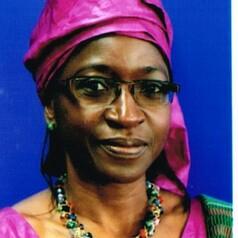
Directrice du Centre de recherche et documentation du Senegal (CRDS), Université Gaston Berger Ms. Fatima Fall NIANG has been a specialist in preventive conservation and manager of model cultural institutions at the Centre de Recherche et de Documentation du Sénégal, an institute of the Université Gaston Berger de Saint-Louis. She has worked there for 29 years (13 years at the museum and 16 years as the Center's director). From 2000-2001, she was a consultant for WAMP in the program entitled: "Identification, Classification, Preservation, Interpretation of Photographic Collections in Museums and Archives in West Africa" funded by the Getty Grant Program, USA. She was a member of the team that put together the file for the inscription of the Island of Saint-Louis on the World Heritage List, the inventory that followed and all the issues of conservation, safeguarding and promotion of cultural heritage and tourism in the northern zone. Since 2009, Mrs. NIANG is a member of the steering committee of the Tourism Development Program. Since 1999, she has been involved in university courses at EPA. Since 2011, she teaches in the Professional Master in Tourism in LSH; from 2008 to 2012, she coordinated the model for the opening of the MDP section of the UFR CRAC at the UGB; From 2011-2012, she was a member of the design team of the model: "management and conservation of heritage" developed by the UEMOA out of 22 courses planned in the area. In 2017, she was co-opted as a member of the International Scientific Committee of the Amadou Mahtar MBOW University, in Diamniadio. She is a UNESCO expert-referent for intangible heritage where she coordinated the registration file of the element "Ceebu jën" on the World Heritage List of Humanity, December 15, 2021. She is co-author of a book entitled: "Ceebu Jën, a Senegalese heritage" published on December 2, 2021. Mrs. NIANG is a member of ICOMOS and ICOM of which she has been the head of the national committee since 2017. She was decorated Knight in the Order of Academic Palms by France in March 2002 and in the National Order of Merit of Senegal in February 2020.
Associate Professor Library, Oklahoma State University Rebecca Weber serves as the Education and Teaching Librarian for Oklahoma State University. She holds a Masters of Library and Information Studies from the University of Oklahoma and a Bachelors in English Education from Northwestern Oklahoma State University. She joined the OSU faculty in 2015. Her research interests include the intersection of disability and young adult literature and the impact of librarianship on the student experience.
Professor of Hydrosystems Engineering, University of Michigan My research interests aim to uncover interactions, mechanisms and feedbacks among various components of natural and human-impacted systems. My group strives to promote both the development of process-oriented models of water, energy and element cycles at various scales and the integration of data and models. The specific foci are land surface hydrology, ecohydrology, floods and climate impact assessments, with a growing emphasis on uncertainty quantification in all these research domains. In the years to come, we will apply both rigorous computational models and field data collection to better understand: water, energy and carbon dynamics in tropical and polar ecosystems; coupled processes of surface-subsurface hydrology and flooding hydrodynamics in natural and managed environments; and impacts and feedbacks associated with the propagation of climate and weather dynamics through hydrologic systems.