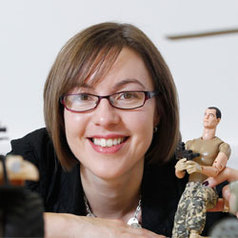
Senior Lecturer in Human Geography, University of Portsmouth I graduated from Royal Holloway (University of London) in 2003 with a BSc (Hons) in Geography. I then went on to complete an MA in Cultural Geography Research (Royal Holloway, 2004) before taking time out of academic study to work in the area of Special Educational Needs in secondary education. I then returned to Royal Holloway to complete a PhD in Human Geography (2009) and Postgraduate Certificate in Skills of Teaching to Inspire Learning (2006). Following completion of my PhD (funded by an ESRC Studentship awarded through the Open Interdisciplinary Competition), I joined the Department of Geography at the University of Exeter in 2009 as a Teaching Fellow. In 2011 I was awarded an ESRC Postdoctoral Fellowship, which I completed at Exeter alongside a period as Visiting Scholar in the Centre for Children and Children Studies at Rutgers (Camden) in the US. Following completion of my postdoctoral studies, I joined Geography at the University of Portsmouth as a lecturer. Teaching Responsibilities I deliver social and cultural geography components of the undergraduate teaching in the department. I am the co-ordinator of two human geography units: Foundations of Human Geography Place: Invented, Experienced, Represented I also contribute to the following co-taught units: Geography, Skills and Prospects Social Geography: Geographies of Wellbeing Research Design and Practice Human Geography: critique and discourse Independent study I jointly teach a European residential field course to Berlin explores urban geographies, more specifically landscapes of memory, subterranean geographies and gentrification. I have contributed chapters to the following book series: The Wiley-Blackwell Companions to Geography series The Open University’s Childhood series Ashgate’s Critical Geopolitics series I have also contributed chapters to the following reference volumes: Springer’s Geographies of Children and Young People series CQ Press Encyclopedia of Consumer Culture Research Ludic (or playful) Geographies My interest in play extends to it role across the lifecourse, and coalesces around three key themes: the relation of play to the everyday, a reconfiguration of the politics of play toward an inwardly oriented vitality, and the ways in which play exceeds representation. I am particularly interested in the critical and ethical potential of playful ways of being and doing and how this can operate as an affirmative mode of critique. Geographies of Material Sensibilities My research examines how material geographies and sensuous geographies can inform each other in productive ways around questions of tactility, affect and relational agency. As a geographer, it is not only the material relations between people and things that are of concern to me, but also the imaginative spaces that can be configured through these relations and how these spaces are enacted in and of the ‘real’ spaces of the everyday. Creative Methodologies Influenced by my concern with material and sensuous geographies, I am interested in exploring ways of investigating non-cognitive and profoundly practical knowledges. Current Research Projects Ludic Geopolitics: children’s play, war toys and re-enchantment with the British military Funding: ESRC Standard Grant (£492,850) This project analyses military action figures for the purpose of examining a ‘ludic geopolitics’: how contemporary geopolitics are expressed and enacted through play. Studies of the ‘military entertainment complex’ have documented the entanglement of the military and toy industry, however work has focused on videogames in a US context. Despite the iconic status of traditional toys like Action Man, and the commercial success of the contemporary HM Armed Forces brand, action figures are yet to receive critical academic attention. Using an ethnographic approach, this project examines children’s embodied practices with the HMAF range. To contextualise and historicise the brand, this work is complemented by archival and museum-based research of the British action figure’s trajectory. This research critically reviews the status of children, mundane everyday practice and the more-than-textual in critical geopolitics, and makes a significant intervention in the interdisciplinary war toy debate by addressing war toys not just as ideological texts, but as objects in playful practice. Please see my blog for more information about my research: http://materialsensibilities.wordpress.com/
Professor of Contemporary Philosophy and Literature, Brunel University London I am one of the leading experts on contemporary, continental philosophy in particular as regards how it relates to contemporary political situations. I specialise in the work of Agamben, Badiou, Derrida, Foucault, and Deleuze. I also work extensively on violence, conflict, terrorism, world politics and technology. I teach a course on violence at Brunel University specialising in issues of capital punishment, technology, terrorism, surveillance and control. I have recently published articles in the media on ISIS decapitations and on the crisis in capital punishment in the US. I have also published academic work on violence, for example: “Agamben, Benjamin and the Indifference of Violence” in Towards a Critique of Violence: Benjamin and Agamben. London: Bloomsbury, July 2015. I am currently working with my agent on a book about the way digital technology has changed our relationship towards violence and death. Provisionally entitled "Snuff" it stretches from the use of social media to develop an intimate digital relationship with images of extreme violence, to the way digital technologies such as drones distances us from acts of war making them seem no more real than video games.
Associate Professor, School of Political Science and Economics, Waseda University Christopher Hobson an Associate Professor in the School of Political Science and Economics, Waseda University. He holds a Ph.D. in Political Science and International Relations from the Australian National University. He is the author of The Rise of Democracy: Revolution, War and Transformations in International Politics since 1776 (Edinburgh University Press, 2015), and the co-editor of The Conceptual Politics of Democracy Promotion (Routledge 2011), which has just been re-issued in paperback.
Research and RHD Coordinator & Lecturer in Sound, Production, Lecturer in Interactive Art Media, VCA., University of Melbourne I am an artist who works in interactive media, cross/multi modality creative arts, and have published and exhibited internationally. I currently work at the Victorian College of the Arts and have 12 RHD students in areas including design, interactivity, community arts, music, and media. My PhD explored the relationship of creator, object and audience through ephemeral computer based artworks.
Professor of Oral and Maxillofacial Surgery, Neuroscience Division, University of Florida My research focuses on the molecular and physiological processes that initiate and maintain chronic pain. In particular, we are examining alterations in the function of the N-Methyl-D-Aspartate (NMDA) class of excitatory amino acid receptor in the spinal cord and the vanilloid receptor – the protein responsible for detecting the burning sensation produced by hot chili peppers – in the periphery following persistent stimulation. The NMDA receptor performs the function of an amplifier in the spinal cord to enhance pain signals, whereas the vanilloid receptor detects pain from heat, inflammation, and chemicals throughout the body. These studies examine changes in the phosphorylation status of these two receptors and alterations in subunits and splice variants as a result of painful experiences. These studies also examine the interaction of the NMDA receptor and vanilloid receptor with endogenous neuropeptides that are released during chronic pain. The ultimate goal of our work is to develop novel strategies to avoid the induction of chronic pain and new therapies to treat chronic pain once it is established.
Director of MIT Senseable City Laboratory, Massachusetts Institute of Technology An architect and engineer by training, Professor Carlo Ratti practises in Italy and teaches at the Massachusetts Institute of Technology. He directs the MIT Senseable City Lab and the design office Carlo Ratti Associati. He chairs the World Economic Forum Global Agenda Council on Future Cities. He graduated from the Politecnico di Torino and the École Nationale des Ponts et Chaussées in Paris, and later earned his MPhil and PhD at the University of Cambridge, UK. Ratti has co-authored over 200 publications and holds several patents. His work has been exhibited worldwide at venues such as the Venice Biennale, the Design Museum Barcelona, the Science Museum in London, GAFTA in San Francisco and The Museum of Modern Art in New York. His Digital Water Pavilion at the 2008 World Expo was hailed by Time Magazine as one of the Best Inventions of the Year. He has been included in Esquire Magazine’s Best and Brightest list, in Blueprint Magazine’s 25 People who will Change the World of Design and in Forbes Magazine’s People you need to know in 2011. Ratti was a presenter at TED 2011 and is serving as a member of the World Economic Forum Global Agenda Council for Urban Management. He is a regular contributor to the architecture magazine Domus and the Italian newspaper Il Sole 24 Ore. He has also written as an op-ed contributor for BBC, La Stampa, Scientific American and The New York Times.