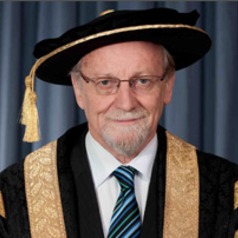
The Hon Gareth Evans AO QC took up his appointment as Chancellor of The Australian National University on 1 January 2010. Professor Evans is an Honorary Professorial Fellow at the University of Melbourne, and Co-Chair of the International Commission on Nuclear Non-Proliferation and Disarmament. He is President Emeritus of the Brussels-based International Crisis Group, the independent global non-governmental organisation working to prevent and resolve deadly conflict worldwide, of which he was President and Chief Executive Officer from January 2000 to June 2009. Gareth Evans has maintained strong academic and scholarly connections throughout his career, lecturing at many universities around the world. In May 2004, he was elected as an Honorary Fellow of Magdalen College, Oxford, and is a member of the International Advisory Board of UN Studies at Yale; the Advisory Council of the Institute for International Studies at Stanford; and the Editorial Advisory Board of the Cambridge Review of International Affairs. In July 2009, he was appointed by the University of Melbourne Honorary Professorial Fellow in the School of Social and Political Sciences. Among other current positions, Gareth Evans is a Fellow of the Foreign Policy Association; a member of the International Council of the Asia Society; a member of the International Advisory Board of the Pew Global Attitudes Survey; and a member of the International Advisory Board of the Asia-Pacific College of Diplomacy, Australian National University. In June 2008, he was made an Inaugural Fellow of the Australian Institute of International Affairs in recognition of his outstanding contribution to Australian international relations.
Professor Charles Lees joined the Department in September 2011. Previously he was at the University of Sheffield. He is currently a Visiting Professorial Fellow at the University of Sussex and a Visiting Fellow at the University of Birmingham. He has also held visiting fellowships at the University of California San Diego, the Australian National University, and the University of Sydney. He has written extensively on comparative politics, policy, and methodology as well as providing media commentary and research and advice for organisations such as the BBC, Sky News, Australian Labor Party, the Green Party of Aotearoa New Zealand, and the Scottish Executive.
My research interests are in the fields of animal behaviour, ecology and conservation, with particular focus on the effects of human activities on wildlife, animal cognition and the behavioural ecology of large herbivores. I have studied African elephants for over a decade, addressing questions on foraging and movement ecology as well as investigating the detailed social and ecological knowledge of elephant family groups and their matriarchs. The research that I have conducted on elephant cognition has involved extensive use of acoustic playbacks, whereby animal vocalisations are broadcast to study the responses of elephants to social and ecological threats. More recently, I have applied these playback techniques to understand the effects of anthropogenic noise - a growing source of environmental disturbance - on animal behavior and wildlife ecology. I am also interested in the role that large herbivores play in ecosystem function and structure in natural and human altered habitats.
Scott L. Montgomery is a university lecturer and author. His research and publications include areas in both the humanities and sciences, in particular history of science, intellectual history, language studies, and energy resources, technology, and security. He is the author, most recently, of Does Science Need a Global Language? (2013) and The Powers That Be: Global Energy for the Twenty-First Century and Beyond (2010). Forthcoming in 2015 are two works: Shape of the New: Four Ideas that Built the Modern World (with Daniel Chirot) and also A History of Science in World Cultures (with Alok Kumar).
Bob De Schutter (MA, PhD) is the C. Michael Armstrong Professor at the College of Education, Health & Society and the Armstrong Institute for Interactive Media Studies of Miami University (Oxford, OH). His interdisciplinary research and teaching interests include game design, the older audience of digital games, and the use of digital games for non-entertainment purposes. He has been invited to teach in Europe, North America and Asia, and his work has been published in leading publications of several academic fields. Bob has served industry as an independent consultant, web developer and entrepreneur, and has founded and chaired the Flemish chapter of the Digital Game Research Association. Prior to joining Miami University, Bob was a researcher and lead designer for the e-Media Lab of the KU Leuven (campus Group T), where he worked on games to facilitate inter-generational knowledge transfer, rehabilitate psycho-motor skills, train entrepreneurial skills, sensitize university students on urban mobility for the disabled, teach the psychology of game design, etc. For more information about him, please visit his personal website at www.bobdeschutter.be.
Leighton is Professor of Economics and Finance. He is Head of Economics Research and Director of the Betting Research Unit and Political Forecasting Unit at Nottingham Business School. Leighton's main teaching is in the area of money, risk, forecasting, efficiency of markets and financial economics.