Nathan Kerrigan is a Research Assistant at Coventry University. He uses ethnographic approaches to explore a number of issues around identity, community and exclusion. This research tends to examine the ways rural identities are maintained and protected from wider social pressures such as urbanisation, neoliberal expansion and population growth. In this, he has focussed on the ways in which prejudices, such as racism, against minority ethnic groups are worked up as unintended consequences.
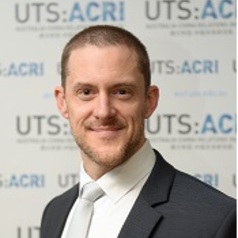
James Laurenceson is currently Deputy Director and Professor at the Australia-China Relations Institute (UTS), University of Technology, Sydney. He has previously held appointment at the University of Queensland, Shandong University (China) and Shimonoseki City University (Japan). His research focuses exclusively on the Chinese economy and has been published in international, peer-reviewed journals such as China Economic Review, China Economic Journal, Journal of Chinese Economics and Business Studies and China and World Economy. The Australia-China Relations Institute (ACRI) at the University of Technology, Sydney, was launched by Foreign Minister Julie Bishop in May 2014. The Director is former Foreign Minister Bob Carr. The aim of ACRI is to illuminate the bilateral relationship across political, economic, cultural and other dimensions.
Dr Rob Nicholls is a lecturer in business law at the UNSW Business School. He was previously a research fellow at Swinburne University of Technology where he worked on spectrum policy matters and a research fellow at the Centre for International Finance and Regulation where he researched the intersection of competition law with financial services regulations. His research applies system and network analysis techniques, commonly used in networked industries, to examine error amplification. Rob is the Independent Telecommunications Adjudicator in a regime established to deal with wholesale disputes arising over both legacy services and migration to the NBN. He has had a thirty-year career concentrating on regulations and governance, particularly in networked industries. He has worked for Webb Henderson, the ACCC and Gilbert + Tobin.
Jennie C. Stephens is the Blittersdorf Professor of Sustainability Science and Policy at the University of Vermont’s Rubenstein School of Environment and Natural Resources and the College of Engineering and Mathematical Sciences. Professor Stephens’ research, teaching, and community engagement focus on socio-political aspects of energy technology innovation, electricity system change, climate change communication, and facilitating social learning in the transition from fossil-fuel to renewables based energy systems. She has contributed to understanding the social dynamics of wind power, carbon capture and storage, and smart grid, and brings experience in stakeholder engagement and communication among experts, practitioners, academics, and the public. Professor Stephens was previously on the faculty at Clark University (2005-2014), and she did post-doctoral research at Harvard’s Kennedy School (2002-2005). She earned her PhD (2002) at Caltech in Environmental Science and Engineering and her BA (1997) at Harvard in Environmental Science and Public Policy.
Dr. Carey W King is the Assistant Director of the Energy Institute at the University of Texas Austin. He performs interdisciplinary research related to how energy systems interact within the economy and environment as well as how our policy and social systems can make decisions and tradeoffs among these often competing factors. The past performance of our energy systems is no guarantee of future returns, yet we must understand the development of past energy systems. Carey’s research goals center on rigorous interpretations of the past to determine the most probable future energy pathways. He has both a B.S. with high honors and Ph.D. in Mechanical Engineering from the University of Texas at Austin. He has published technical articles in the academic journals Environmental Science and Technology, Environmental Research Letters, Nature Geoscience, Energy Policy, Sustainability, and Ecology and Society. He has also written commentary for Earth magazine discussing energy, water, and economic interactions. Dr. King has several patents as former Director for Scientific Research of Uni-Pixel Displays, Inc.
Donald E. Heller is Provost and Vice President of Academic Affairs and a professor of education at the University of San Francisco. He is responsible for the university’s five schools, libraries, academic affairs, student life, enrollment management, online programs, international relations, and diversity and community outreach for the university’s 10,800 students,1,200 faculty, and 1,000 staff. His teaching and research is in the areas of educational economics, public policy, and finance, with a primary focus on issues of college access, choice, and success for low-income and minority students. He has consulted on higher education policy issues with university systems and policymaking organizations in California, Colorado, Florida, Kansas, Massachusetts, Michigan, New Hampshire, Tennessee, Washington, Washington DC, and West Virginia, and has testified in front of Congressional committees, state legislatures, and in federal court cases as an expert witness. Prior to his appointment in January 2016, he was Dean of the College of Education at Michigan State University. Earlier appointments included Director of the Center for the Study of Higher Education and professor of education and senior scientist at The Pennsylvania State University, and assistant professor of Education at the University of Michigan. Before his academic career, he spent a decade as an information technology manager at the Massachusetts Institute of Technology.