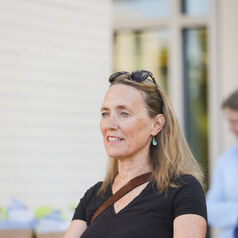
Professor of Sustainability Management, University of Waterloo Dr. Amelia Clarke has been working on environment and sustainability issues since 1989, including as President of Sierra Club Canada (2003-2006), the first Director of the University of Waterloo's Master of Environment and Business degree (2009-2018) and the Associate Dean Research for the Faculty of Environment (2018-2022). She is now a Full Professor in the School of Environment, Enterprise and Development (SEED) at the University of Waterloo.
Managing Director, Youth & Innovation Project, University of Waterloo Ilona is the Co-creator and Managing Director of the Youth & Innovation Project at the University of Waterloo. She is an award-winning social innovator and a regular voice in the Canadian media advising business, civil society and government on how they can tap into the value and unique abilities of young people. She has extensive leadership and governance experience having co-founded several successful organizations. In 2004, she Co-founded Apathy is Boring, a non-partisan social enterprise that educates Canadian youth about democracy and encourages them to vote. Ilona is a PhD student in political science at the University of Waterloo, a speaker with the Speaker Spotlight agency and an Ashoka Fellow.
Senior Lecturer in Critical Media Studies, Auckland University of Technology Kia ora! I'm a senior lecturer and researcher in the Critical Media Studies Department, at Auckland University of Technology's Te Kura Whakapaho (School of Communication Studies). My current research focuses on media literacy, promotional culture, and childhood studies, and the mediated representations of gender and religion. I am particularly interested in how the media helps shape our identity and empowering (particularly young) people to have agency over how they interact with media.
Professor of Law, University of British Columbia Professor Dauvergne has been working in the area of refugee, immigration, and citizenship law for thirty years. For a decade she held the Canada Research in Migration Law. In 2012, Dauvergne was named a Fellow of the Trudeau Foundation in recognition of her contributions to public discourse in Canada. In 2019 she was honoured with a Queen’s Counsel designation. She has written three books that take a broad perspective on the theoretical underpinnings of the interrelated fields that comprise border law, including considering how human rights principles and discourses fit into a migration and citizenship framework. Dauvergne is also an editor or co-author of five other volumes, including Canada’s immigration and refugee law casebook. Much of Dauvergne’s work engages feminist critique of the law, and the place of women in immigration, refugee, and citizenship laws. Catherine Dauvergne served as the eighth dean of the Peter A. Allard School of Law from 2015-2020 and as Provost of Simon Fraser University from 2020-22. In 2021, Dauvergne was elected a Fellow of the Royal Society of Canada.
Lecturer in Law, University of Salford As a law lecturer at the University of Salford, with 11 years in higher education, my focus is on the law and technology, specifically on AI in legal education. Having lectured at several universities, my expertise is recognised beyond a single institution. I currently serve as an external examiner, upholding quality for assessment. My previous position as Head of Digital Education, demonstrates a commitment to innovative teaching methods using technology for learning and teaching. I am a recognised Senior Fellow of Advance HE. Recently I have presented at conferences and AI events, capturing the attention of fellow educators interested in the relationship between AI and education. My scholarly contributions include a publication on assessment, AI and legal education. I co-authored an expert comment on AI and the judiciary, collaborating with a law firm partner.
Professor of Comparative Cognition, University of Sussex Gillian is a comparative psychologist interested in human and non-human primate cognition. Her research involves the integration of modern technology and the convergence of methodologies across multiple disciplines. Gillian began her research studies in primate cognition as an undergraduate in cognitive science at the University of California San Diego. She subsequently earned a D.Phil. from Oxford University where she investigated the neural correlates of human language and attention using neuroimaging methods (EEG, PET, fMRI). As a postdoctoral student, Gillian honed her developmental psychology knowledge running behavioral and imaging studies of infant cognitive development at the Centre for Brain and Cognitive Development under the direction of Mark Johnson. Using knowledge of human cognition and quantitative neuroscience techniques, a second postdoctoral position awarded by the Daphne Jackson Trust at the University of Sussex, provided an opportunity to develop a new multidimensional method (MDM) to investigate naturalistic behavior across disparate populations. This research focused on gaining a better understanding of both the evolution and the development of human and non-human primate nonverbal communication skills through the quantitative assessment of western lowland gorilla behavior.