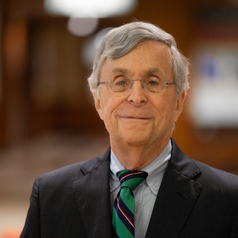
Frank U. Fletcher Chair in Law, Wake Forest University I've written ten books, contributed chapters to sixteen additional books, authored or co-authored over fifty-five articles. I am also the Vice-President and founding member of the Center for Progressive Reform (CPR), a nonprofit research and advocacy organization,Before coming to Wake Forest, I taught at the University of Kansas where I was a distinguished professor. I have also been a distinguished visitor at Oxford University, University of Padua, the law schools at the University of Texas and the University of North Carolina, and the School for Policy and Environmental Affairs (SPEA), University of Indiana, Bloomington. My latest book, coauthored by Joseph Tomain Dean Emeritus and Wilbert and Helen Ziegler Professor of Law in the University of Cincinnati College of Law, is How Government Built America, forthcoming from Cambridge University Press in June, 2024.
Associate Professor, Dental Science, Trinity College Dublin I run the Oral Microbiome research group in the School of Dental Science. My research focuses on the pathogenicity of oral microorganisms, specifically the fungal pathogen Candida albicans and the oral bacterium Fusobacterium nucleatum. Our research involves a combination of molecular genetics, genomics and transcriptomics. We also carry out 16S profiling of the oral microbiome to better understand oral disease. Our research is carried out in the Microbiology laboratory at the Dublin Dental University Hospital, which is on the campus of Trinity College Dublin.
Senior Lecturer in Fluid Mechanics, Imperial College London I am a Senior Lecturer in the Fluid Mechanics Section in the Department of Civil and Environmental Engineering at Imperial College London. My research focuses on the complex mechanics of turbulent multiphase flows in civil and environmental engineering problems, such as the transport of plastics/litter in rivers or the hydraulics of high-head hydraulic structures. I am also interested in the role and risks of water infrastructure in the context of climatic and anthropogenic futures.
Professor of AI and Spatial Computing, Liverpool Hope University I am a Professor in Computer Science. Having attained my Ph.D. in 1995, researching in the fields of intelligent agent systems, I joined a newly formed group at Liverpool University dedicated to developing and promoting innovative technological solutions for local businesses. After implementing the first electronic shopping mall in the UK, I spent eight years providing technical leadership on many Internet and Intranet projects. These projects usually involved exploiting newly emergent technology. My current research interests are derived from experience gained in both my academic and industrial backgrounds, and include: AI, Augmented and Virtual Reality and Spatial Computing.
Assistant professor, Radboud University David de Boer is an assistant professor of political history at Radboud University Nijmegen and a postdoctoral research at the University of Amsterdam. He is broadly interested in how people in the past thought about moral obligation, created transnational solidarity networks, and managed migration in a globalizing world. His award-winning first book, The Early Modern Dutch Press in an Age of Religious Persecution: The Making of Humanitarianism (Oxford University Press, open access, 2023) explores how 17th century refugees leveraged the printing press to draw international attention to their suffering – thereby laying the foundations for modern humanitarianism. David studied history at Utrecht University and received his PhD from the University of Konstanz and Leiden University (joint doctoral degree). He was a visiting scholar at the German Historical Institute Washington, the European University Institute, the Leibniz Institute of European History, and Harvard University.
Lecturer, Griffith Law School, Griffith University I am a Lecturer at the Griffith Law School at Griffith University on the Gold Coast. My research focuses on the interplay between data, privacy, algorithms and identity. In otherwords, how #hyperconnection, and all things digital, influence the individual's identity, reputation and undermine personal autonomy.