


 FxWirePro- Major Crypto levels and bias summary


The RBNZ precisely mentioned last month that it would be returning to the easing table, and like the consensus, we expect a 25bp OCR cut to 2.0% in tomorrow’s monetary policy.
You may probably know that the China has been the biggest contributor of Aussie and Kiwis trade balance. Earlier Monday, data showed that China’s imports declined by 12.5% in July, compared to expectations for a 7.0% drop. Exports fell by 4.4% last month, compared to expectations for a 3.0% fall.
As a result of this speculation in the FX market, the New Zealand dollar moved lower sensing more bearish pressures in the weeks to come especially after data showed that China’s imports dropped far more than expected last month.
Technically, more downside traction is foreseen on the monthly chart as the current prices are well below 7&21EMAs with leading oscillators to signal selling momentum.
Currency Option Strategy: NZD/JPY Short Put Ladder
Rationale: Unlimited downside and limited upside profit potential and higher IVs (more than 15% favors option holders.
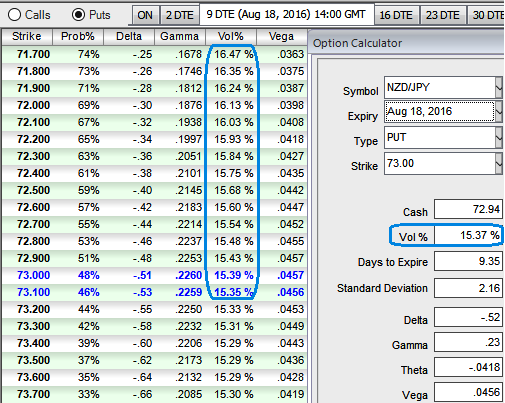
1W ATM IVs are trending higher at 15.37% which means the FX market thinks the price has the potential for large movement in either direction during RBNZ’s monetary policy season, but you can observe higher vols and probabilistic flashes as the put contracts drift towards out of the money strikes.
How to execute: Short 1W (1%) ITM put option and simultaneously add longs on 1M ATM -0.49 delta put option and one more 2M (1%) OTM -0.35 delta put option.
Maximum returns are limited to the extent of initial credit received if the NZDJPY rallies above the upper breakeven point (BEP) but large unlimited profit can be achieved should the underlying exchange rate of NZDJPY makes vivid downswings below the lower BEP.
Since the short put ladder is an unrestricted return with partial risk bearing strategy that is deployed because, in addition to the puzzling uptrend in a short term and downtrend in long-term, we think that the NZDJPY would also perceive significant volatility in the near term.













