


 Bank of America Upgrades T-Mobile to Buy, Says LEO Satellite Fears Are Overdone
  Sara Duterte Impeachment Trial Opens, Putting 2028 Philippine Election in Focus
  ICC Says Darfur War Crimes Probe Reaches Breakthrough in Sudan Investigation
  Texas Man Charged After Fatal Tesla Full Self-Driving Crash in Katy
  Goldman Sachs Flags 3 Key Risks Ahead of Europe’s Earnings Season
  Trump Orders DOJ Investigation Into Exxon, Chevron Over High Gas Prices
  Gold Surges Past $4150 on Dovish Fed Signals and Weak Jobs Data; Bullish Outlook Prevails
  Judge Orders $5.8 Million Payment to E. Jean Carroll After Trump Loses Appeal Bid
  DOJ Orders Crackdown on Birth Tourism After Supreme Court Upholds Birthright Citizenship
  Paramount-Warner Bros. Discovery Merger Faces Lawsuit From 12 States
  New Mexico AG Accuses DOJ of Delaying Jeffrey Epstein Ranch Investigation
  Citi Raises TSMC Price Target as AI Chip Demand Strengthens Growth Outlook
  Gold Pulls Back After Hitting $4,180 as Geopolitical Risk Sends Crude Higher





In little more than 100 years, humans have radically transformed the sky: chemically, territorially and militarily. In this increasingly contested space, technological developments are accelerating the transformation. New forms of military and commercial exploitation are increasing the disparity of power between those who dominate airspace and outer space, and the billions of people on the ground affected by the impacts.
People are increasingly vulnerable to being tracked, watched and targeted from above. The use of combat drones is escalating and new robotic assailants are being developed. Individuals are at growing risk of being tracked and targeted through data mining. For instance, geolocating via smartphones and mapping geotagged photographs reveal a person’s “patterns of life”.
Meanwhile, emerging developments in geoengineering technologies designed to combat global warming raise major ethical concerns in terms of climate governance and its potential impact on people on a global scale.
The psychological impacts of unrelenting threats from the sky are debilitating and long term. And so in this rapidly changing world, human rights protection needs to evolve. It is in this context that, as argued recently in the European Human Rights Law Review, we propose the recognition of a new human right to protect the freedom to live without physical or psychological threat from above.
Airspace
The principle that every state has complete and exclusive sovereignty over the airspace above its land and sea territory, declared by the Chicago Convention on International Civil Aviation 1944, is a universally accepted principle of international law. It was first proclaimed in the Paris Convention for the Regulation of Aerial Navigation 1919, not long after the first full-scale use of airborne chemical warfare at Ypres in World War I in 1915.
Airspace traditionally signifies “the spatial dimension where states exercise their jurisdiction or control for aviation and defence”. Airspace is therefore considered to be an area-based concept. But this does not account for the complex and diverse ways in which the sky is used, impacted on or exploited, or for how it is valued, understood and experienced across different cultures. The reach and impact of activities in airspace increasingly transcend territorial boundaries.
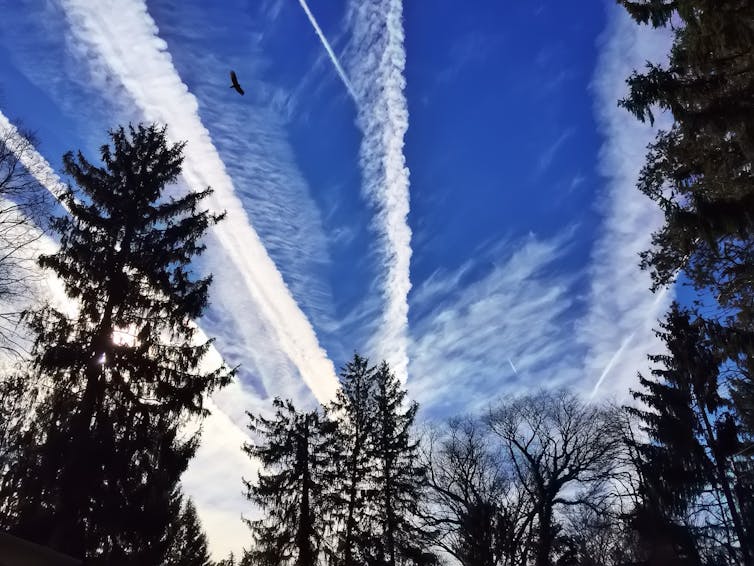
Flight paths. jal33/flickr, CC BY
Beyond airspace lies outer space. As declared by the Outer Space Treaty 1967, outer space is not subject to national appropriation by claim of sovereignty, by use or occupation, or by any other means. The boundary between airspace and outer space has not yet been defined but the resolution of that issue is less urgent than how we protect people from threat or harm from the space above our heads, regardless of the latter’s legal status.
Introducing human rights
Given the limited representation of airspace in international law, and in the context of accelerating geopolitical, technological and environmental change, we need to radically reassess how we perceive airspace in the legal sense.
A key aspect of the legal framework of airspace in need of further development is the human rights dimension. Some might argue that the the freedom to live without physical or psychological threat from above is already covered by existing rights, such as the right to life or the right to freedom from inhuman or degrading treatment.
But there is precedent for human rights which were once subsumed within broader rights or freedoms becoming specifically identified and explicitly protected as thinking and needs evolve. For example, freedom of the arts and sciences as proclaimed in the Charter of Fundamental Rights of the EU has been carved out of the freedom of thought and expression.
Similarly specific and explicit human rights protection is required in the face of the rapidly changing nature and use of airspace. We need to anticipate future developments and interrogate and challenge the narrow terms by which airspace is defined and represented in law.
The Airspace Tribunal
Our hypothesis is being tested at a people’s tribunal in a series of hearings around the world. This “Airspace Tribunal” has begun to do this by engaging experts, audiences and the wider public in dialogue and debate about the rapidly changing use of airspace.
The inaugural hearing, held in London in September 2018, involved representations on a range of key issues, including those detailed above. Further hearings will take place around the world to ensure that thinking is shaped by a rich and vital diversity of expertise, experience and perspective. As befits a people’s tribunal, the public audience at our hearings are the judges, challenging the traditional state-centric view of how international law is created.
The hearings are being recorded and transcribed to document the drafting history of the proposed new human right. Ultimately, our intention is to present states and international organisations with a compelling people-focused proposal.
As we approach the 70th anniversary of the Universal Declaration of Human Rights and the centenary of the Paris Convention, the combined physical and psychological impacts of these growing threats from the air require a correspondingly radical response. Human rights as a tool for ensuring human dignity and peaceful existence must be dynamically engaged with the fast evolving threats and conditions of our time.







