Artificial-intelligence demand is driving a rapid expansion of data-center capacity, with JLL forecasting global capacity will rise from 103 gigawatts (GW) to 200 GW by 2030 and intensifying pressure on electricity networks.
JLL’s 2026 Global Data Center Outlook projects capacity will increase from 103 GW to 200 GW by 2030. The property consultancy says the sector could grow at a 14% compound annual rate through the decade, with AI workloads accounting for half of capacity by 2030.
The buildout comes with a substantial investment requirement. JLL estimates up to $3 trillion could be invested over the next five years, including new real-estate assets and debt financing.
Electricity demand is already rising quickly. The International Energy Agency says data centers consumed about 415 terawatt-hours in 2024, or 1.5% of global electricity use, and that consumption has grown by about 12% a year since 2017. The United States accounted for 45% of global data-center electricity use, followed by China at 25% and Europe at 15%.
The UAE is positioning itself as a regional hub. A 5 GW UAE-US AI Campus was unveiled in Abu Dhabi in May 2025, according to the U.S. Department of Commerce. Phoenix Group, an Abu Dhabi-based digital-infrastructure operator, separately announced an 18 MW AI facility in Lyon, France, with DC Max.
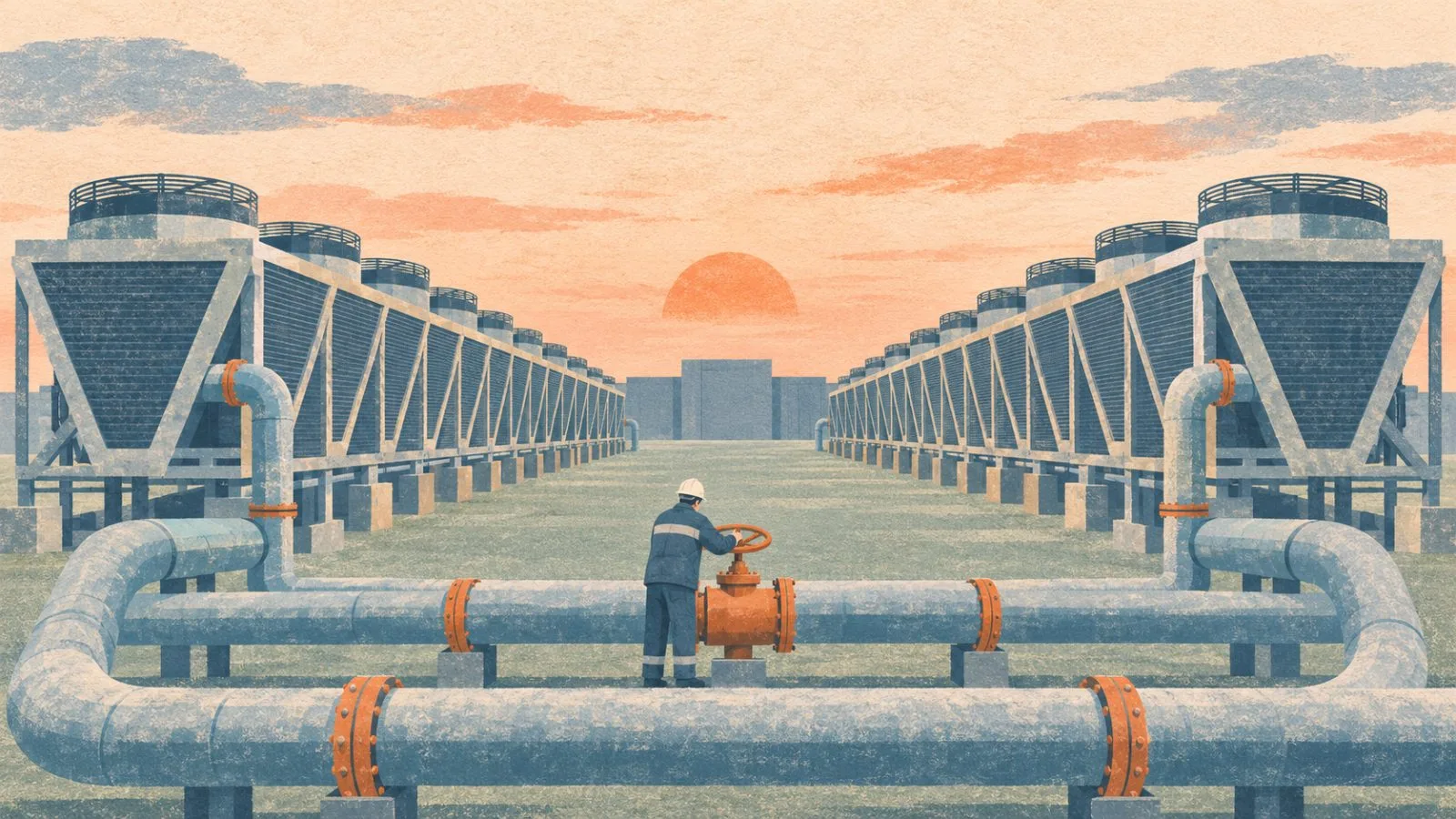
The National reported that the expansion is increasing competition for electricity and prompting concerns about cooling-water demand and emissions. Ahmad bin Thaneya of New York University Abu Dhabi told the outlet that clean-power supply should expand alongside data-center demand, rather than simply reallocating existing renewable generation.
Demand may remain strong in the near term. Mark Daley, chief AI officer at Western University, told The National that companies are competing to develop more capable models and that the main constraint is finding grids able to support very large facilities.
Longer term, analysts see possible limits. Arthur D Little’s Raymond Khoury said saturation could emerge around 2035 as processors become more efficient and specialized models reduce computing requirements, according to The National. Xavier Fresquet of Sorbonne University Abu Dhabi also pointed to a shift toward more decentralized computing on phones and other devices.
For now, the investment cycle is still expanding. Whether it can continue will depend on access to power, the availability of water for cooling and the pace at which AI efficiency improves.