In the new Netflix series All the Light We Cannot See, a blind French girl called Marie-Laure LeBlanc makes illicit radio broadcasts from her uncle’s house in Nazi-occupied France. We are told that Marie-Laure has congenital cataracts in both eyes. But what is this condition?
The word “cataract” comes from the Latin word for waterfall and describes a condition where the usually transparent lens of the eye is cloudy or opaque. This prevents a clear image being projected onto the back of the eye and causes poor vision.
Many people will have heard of cataracts in the context of older adults because the lens becomes cloudier throughout life, slowly causing blurry vision. Surgery to remove the cloudy lens and replace it with a clear plastic one is commonplace and quite routine nowadays. In fact, cataract surgery in adults is one of the most common operations performed in healthcare systems across the world.
However, around three in 10,000 children are born with cataracts (congenital cataracts) and this poses a much more urgent problem. During very early childhood, the brain learns to see and so anything causing poor vision must be dealt with rapidly to allow the brain time to adjust.
In modern healthcare systems, most babies with cataracts have surgery before the age of ten weeks to avoid very poor lifelong vision. Some children are born with milder cataracts and then they progress (become cloudier), as we can assume was the case for the fictional character Marie-Laure. Nowadays, these children are watched closely because their cataracts can progress slowly, or very quickly, depending on their cause.
Surgery is offered when the potential benefits outweigh the risks. Marie-Laure’s story is quite different. In the 1940s, surgery was far riskier and a far cry from modern micro-surgery under general anaesthetic. Most children had no treatment at all.
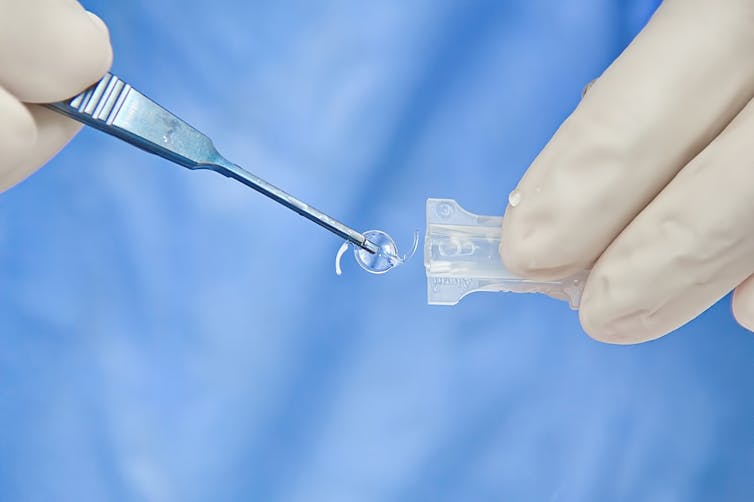
In cataract surgery, the cloudy lens is replaced. Simpotich Photography/Shutterstock
Treatment is very different today
In most developed healthcare systems in 2023, newborns are examined routinely after birth and one part of this is to look for eye problems, including cataract. This was not the case in the 1940s, and so how Marie-Laure’s cataracts developed and at what age, is probably unclear. This is important, because there are many different underlying causes of congenital cataract, including conditions affecting just the eyes, conditions affecting other parts of the body such as Nance-Horan syndrome, and even life-limiting metabolic diseases.
Nowadays, when a cataract is found in newborns or children, doctors seek these conditions using genetic testing and other blood tests.
Importantly, congenital cataracts which do get worse in childhood (as is the story for Marie-Laure) are more likely to be due to conditions that affect other parts of the body, and so it is possible that Marie-Laure also had other medical problems related to an underlying condition.
One critic praised All the Light We Cannot See for being “a significant leap forward for disability inclusion, rights and representation on screen and beyond”. Marie-Laure’s teenage character is played by Aria Mia Loberti, an American actor who has a congenital eye condition called achromatopsia. And the young Marie-Laure is played by Nell Sutton, who has another rare condition called congenital glaucoma.
Achromatopsia causes low vision, moving eyes and no colour vision at all, and congenital glaucoma causes the pressure inside the eye to be very high and when untreated, causes loss of vision and the eyeball to enlarge way beyond its normal size. In the 1940s little would have been known about any of these conditions or indeed, how to treat them.
Medical treatment, surgery and support have changed vastly since the 1940s, but the challenges faced by young people living with low vision, despite the cause, are still very real.