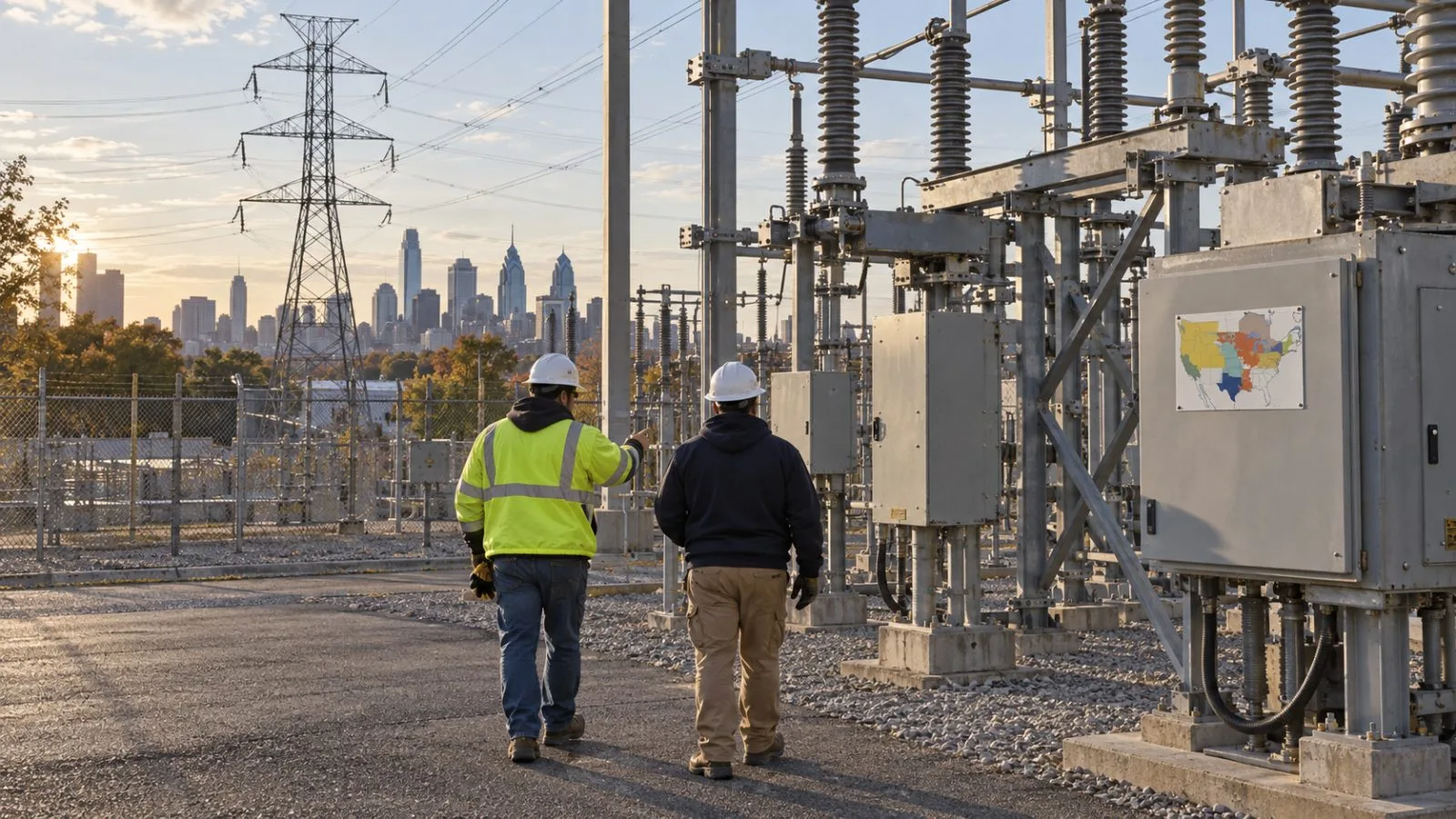
Amazon and Google have signed long-term agreements tied to nuclear plants serving the PJM grid, as high capacity costs sharpen debate over how data-center demand affects other electricity customers.
Constellation and Amazon announced a 20-year deal Sept. 30 covering 690 megawatts from Maryland’s 1,790-megawatt Calvert Cliffs plant. The figure includes an approximately 190-megawatt upgrade expected to enter service between 2030 and 2032. Constellation said the plant’s output will remain available to the regional market, while a separate retail contract covers Amazon’s PJM operations.
Google’s 20-year deal, announced Oct. 6, supports upgrades at 11 operating Constellation units in Illinois, Pennsylvania and New Jersey, adding 890 megawatts of capacity. Constellation said it plans to put more than $4.3 billion of new investment into the work. A separate 15-year agreement covers 2,700 megawatts of energy supply from its PJM fleet. The companies project the nuclear work will sustain about 4,400 existing jobs and support roughly 7,200 construction jobs.
The announcements did not disclose power prices or quantify any effect on capacity charges for other customers. They extend a broader debate over hyperscalers helping fund utility power and grid spending.
Monitoring Analytics, PJM’s independent market monitor, estimated data centers accounted for $6.3 billion, or 38.2%, of the $16.4 billion associated with the 2028/2029 capacity auction. For the 2025/2026–2028/2029 delivery years, the monitor calculated $29.4 billion in data-center-related charges out of $63.6 billion in total charges (46.2%), using existing and forecast demand. The monitor recommended a separate capacity auction for data-center load so those facilities pay for their associated capacity costs; that is a recommendation, not a current rule.
PJM says the $16.4 billion auction figure does not directly determine customer bills. Load-serving entities have different mixes of owned generation, bilateral deals and market purchases, and retail bills include costs beyond capacity. The Natural Resources Defense Council estimates that, if current trends continue, an average household in the region could pay about $70 more per month by 2028. That is a projection, not a confirmed increase.
PJM’s July auction for 2028/2029 cleared at $325 per megawatt-day, the approved price cap. It secured 138,318 megawatts; Fixed Resource Requirement regions contributed another 10,864 megawatts, bringing total available capacity to 149,182 megawatts, 6,831 megawatts below the reliability requirement. PJM said the shortfall would narrow the reserve cushion and raise operating risk, but did not mean service would necessarily fail.
On Oct. 9, the Federal Energy Regulatory Commission (FERC) accepted some tariff revisions and rejected others in PJM’s proposal for an interim service for new large loads without their own supply. Under the proposal, those customers could connect but might face curtailment during grid stress. FERC Commissioner David Rosner said he supported rejecting most of the filing.
The International Energy Agency estimates data centers used about 415 terawatt-hours worldwide in 2024 and projects about 945 terawatt-hours by 2030 in its base case, with AI-related accelerated servers a major source of growth. PJM’s next Base Residual Auction, for the 2029/2030 delivery year, is scheduled for December 2026.