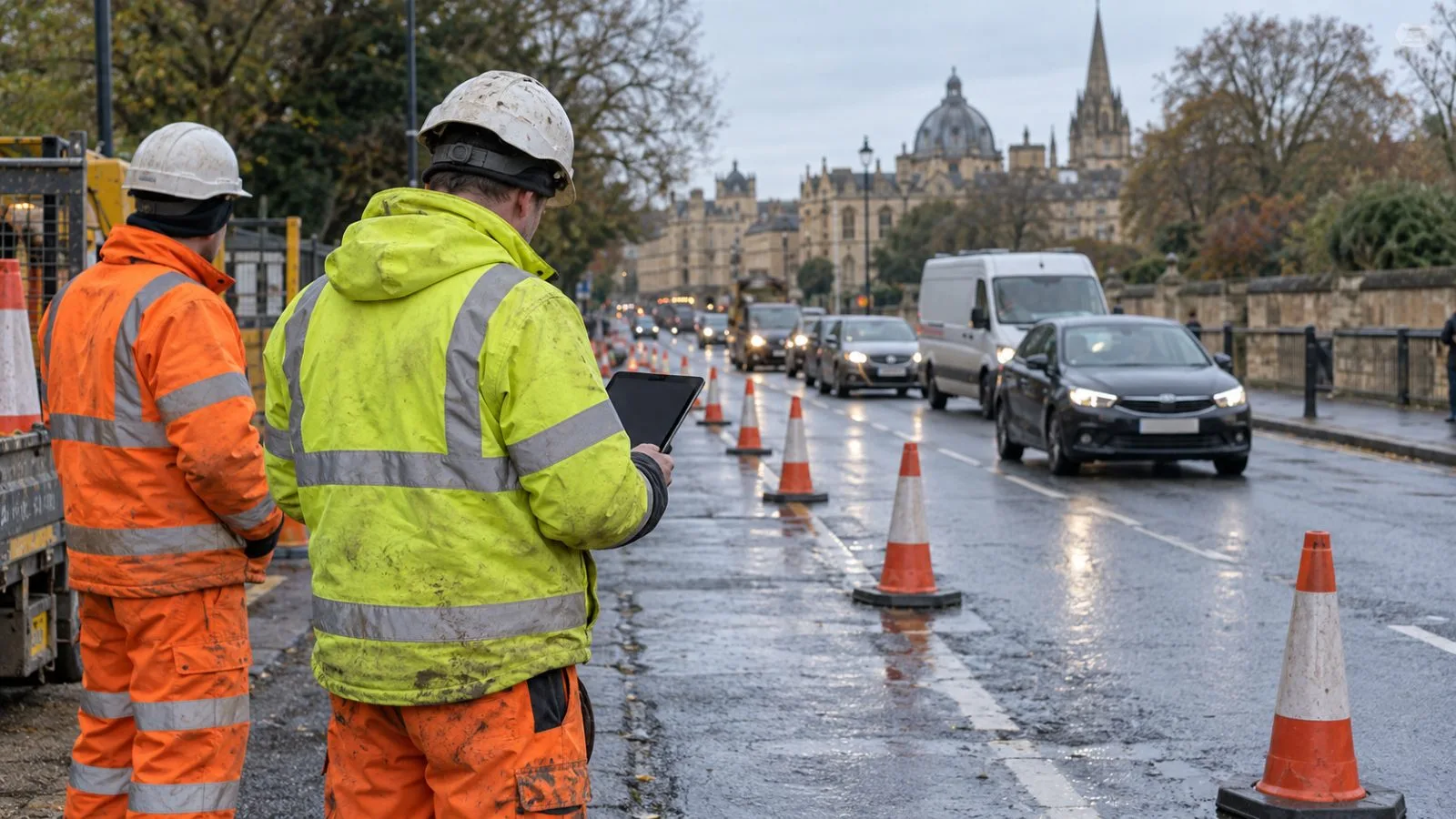
Amey agreed to bring AI-enabled risk assessments to more than 2,500 field workers, while the pilot figures released so far track software use rather than whether the tools prevent injuries.
FYLD announced the long-term agreement on March 12, 2026. Its workflow for Amey’s Highways division includes pre-site inspections, shift briefings, point-of-work risk assessments, remote support and job closure.
FYLD said its three-month pilot covered more than 500 jobs. An AI assessment was included in 95% of those jobs, the company said, and 85% of users used the platform consistently. The announcement reported improved preparation and fewer aborted jobs, but gave no injury or accident results for the trial.
In an April 8, 2025, release, FYLD credited its AI-driven safety assessments with contributing to a reduction of up to 48% in worksite injuries and incidents worldwide in 2024. The company did not state how many sites were included, what comparison it used or whether an independent party evaluated the result.
A 2026 scoping review by Milan Jovin, Igor Pesko and Vladimir Mucenski, published in proceedings of the International Association for Automation and Robotics in Construction, examined 25 peer-reviewed studies on AI-enabled construction autonomy and robotics. The authors classified 68% of the studies as case work or simulations; 16% involved robust empirical testing. Reported safety benefits included hazard detection, reduced worker exposure and compliance monitoring, with results varying by context. The review covers a broad research field, not every risk-assessment product.
A separate bulletin from the U.S. National Institute for Occupational Safety and Health (NIOSH) describes challenges for construction robotics: work areas change as projects advance, while dust, weather, lighting and visual obstructions can affect robots’ sensing and visibility. Northumbria University assistant professor Waleed Umer told CNBC that AI should be an “extra pair of eyes” and should not replace supervision.
The Health and Safety Executive (HSE) recorded 25 construction worker deaths in Great Britain in 2025/26p, compared with 35 in 2024/25p and an annual average of 37 over 2021/22–2025/26p. The national figures do not identify whether AI was used at the sites. HSE says it will finalize the latest data in July 2027.