


 Oil Prices Slip as Trump Rules Out Iran Strike Before Midterms
  Asian Stocks Mixed as OpenAI Revenue Concerns Hit Chipmakers
  Oil Prices Rise as Hormuz Risks Offset IEA Stock Release
  Oil Prices Rise as Gulf Hurricane and Middle East Supply Risks Mount
  Fed Minutes Signal Another Rate Hike by Year-End
  Gold Prices Fall as Fed Signals Another Rate Hike
  Iran Refuses to Halt Uranium Enrichment Amid US Nuclear Demands
  Gold Prices Rise as Hormuz Tensions Fuel Inflation Risks


 Add as a preferred source on Google
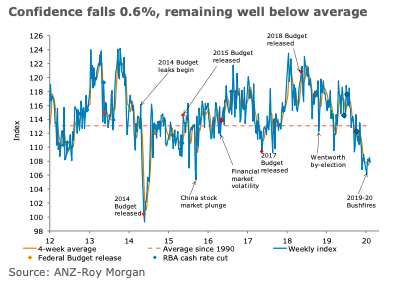
Australia’s ANZ-Roy Morgan consumer confidence fell 0.6 percent last week, reversing a bit over half the prior week’s increase. This continues the recent sawtooth pattern. Confidence remains well below average.
In a repeat of last week’s pattern, there were largely oversetting moves within the sub-components of financial and economic conditions. ‘Current financial conditions’ dropped 3 percent, while ‘future financial conditions’ were up 3.8 percent.
In a similar pattern, the 4.1 percent drop in ‘current economic conditions’ didn’t quite offset the 5.3 percent lift in ‘future economic conditions’.
‘Time to buy a major household item’ fell 5 percent, to its lowest level since mid-December. The four-week moving average of ‘inflation expectations’ was unchanged at 4.1 percent.
"Consumer confidence has displayed a sawtooth pattern in recent weeks, with offsetting moves in many of the components leading to a lack of overall direction. Last week’s upbeat assessment of the outlook by the RBA may have buoyed ‘future economic conditions’, which rose to their highest level since mid-November. ‘Future financial conditions’ also rose sharply, jumping to their highest level since early November. Sentiment around current conditions, though, was lower, as were views on whether it was ‘time to buy a major household item’. Heavy rain and floods in parts of the east coast and the coronavirus epidemic may have contributed to the weakness in these aspects of the survey. Overall, consumers are cautious, and it is difficult to see this lessening any time soon," said David Plank, ANZ’s Head of Australian Economics.







