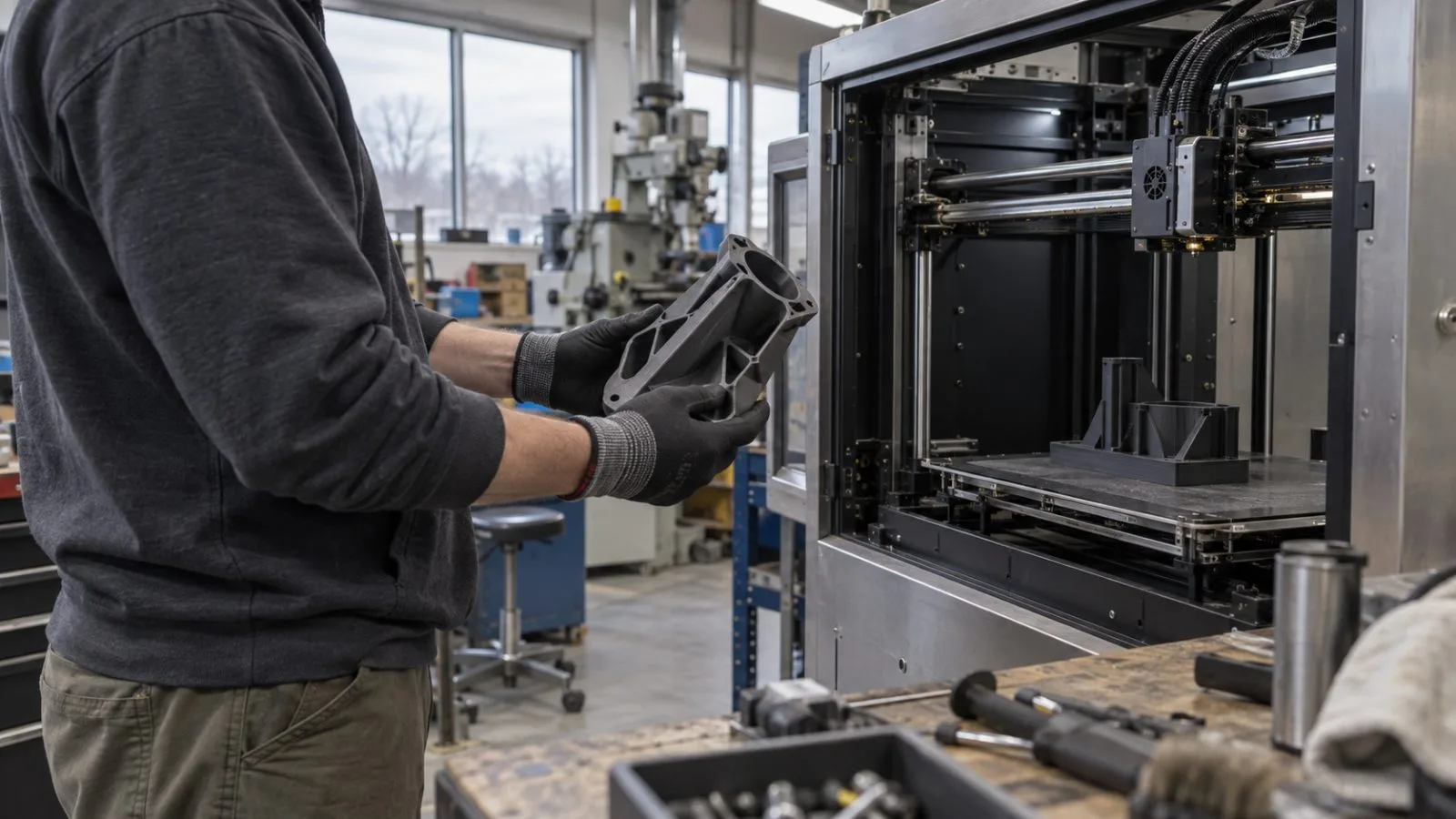
Automation Alley said Thursday it received a Phase I task order valued at $7.5 million for secure, distributed 3D-printing work to support U.S. Army supply chains.
The Michigan-based industry group said the task order has a base and an option but did not disclose their separate values or say how much of the amount is committed. Automation Alley cited supply disruptions, long lead times and limited U.S. production capacity for legacy defense components as problems the effort aims to address. The work is under the Industrial Base Analysis and Sustainment (IBAS) program, which the U.S. Department of War describes as an effort to strengthen and modernize the defense industrial base and address supply-chain vulnerabilities.
The Phase I plan calls for an encrypted workflow aligned with Cybersecurity Maturity Model Certification (CMMC) and cybersecurity standards set by the National Institute of Standards and Technology (NIST). The project also plans to select polymer and metal weapon-system components for validation and produce parts using additive manufacturing processes the team has validated. A planned demonstration will transmit smart product recipes to manufacturers at multiple sites and pair each part with a digital quality-assurance recipe.
NCDMM, the National Center for Defense Manufacturing and Machining, will be prime contractor under its indefinite-delivery, indefinite-quantity contract. Automation Alley named Markforged and Fraunhofer USA as project partners.
Tom Kelly, Automation Alley's executive director and CEO, said Phase I would give the team a chance to show that secure distributed additive manufacturing is ready. He described the demonstration as an opportunity to do so “in a real and rigorous way.”
The task order is part of Project DIAMOnD, Automation Alley's distributed manufacturing initiative. An Automation Alley case study says an earlier effort activated a network of more than 300 Markforged industrial 3D printers and used the network to produce more than 7,000 tourniquet clips for Ukraine. The case study said intellectual-property protection was not a constraint in that operation, while the current project focuses on securing manufacturing instructions.