


 Fed’s Hammack Says More Data Needed Before Next Rate Move
  BlackRock’s Rick Rieder Favors Bonds Over Stocks as Treasury Yields Surge
  Strategy’s STRC Nears $100, Raising Prospects for Major Bitcoin Buys
  China Shuts 670 Banks as Bitcoin Eyes Financial Risks
  BOJ Signals Faster Rate Hikes as Inflation Risks Grow
  Bitcoin Outflows From Binance Hit Three-Year High as Whales Accumulate
  JPMorgan CEO Jamie Dimon Warns Mythos AI Raises Cyber Risk Tenfold
  Cardano Price Surges 10% as ADA Targets $0.30
  Fed’s Williams Signals One More Rate Hike Before Year-End
  European Stocks Fall as Oil Rises Ahead of Fed Minutes
  Gold Prices Rise as Dollar Weakens, Treasury Yields Ease
  Iran Tanker Attacks Surge as Hormuz Oil Flows Near Prewar Levels
  Fairshake Backs 32 Pro-Crypto House Candidates
  Japan Real Wages Rise 1.5%, Supporting BOJ Rate Hikes
  US-Led Coalition Targets Global Factory Overcapacity


 Add as a preferred source on Google
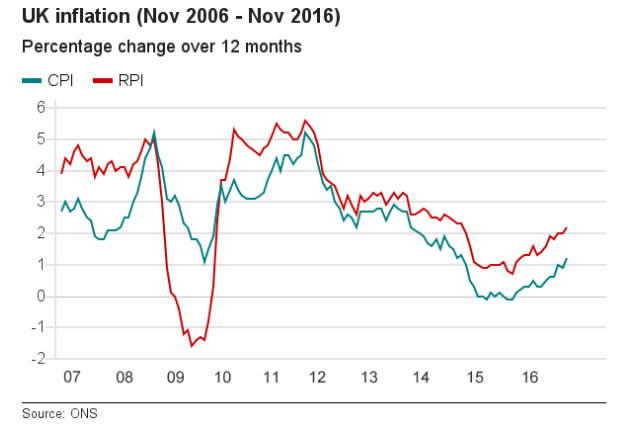
UK CPI inflation resumed the broad upward trajectory in November. Data released on Tuesday by the Office for National Statistics showed UK consumer prices rose 1.2 percent compared with a year ago, beating economists’ expectation for a 1.1 percent annual rise. The CPI ‘core’ rate (excluding energy, food, alcohol and tobacco) mostly drove the move, rising to 1.4 percent y/y from 1.2 percent in October.
November’s rise in headline inflation was relatively broadly-based. Details of the report showed expensive clothing and the impact of June’s Brexit vote on the prices paid by consumers for technology goods pushed UK's inflation to more than two-year high in November. British factory gate prices rose at an annual rate of 2.3 percent, while prices paid by factories for materials and energy fell more than 1 percent on the month but were up by nearly 13 percent compared with November 2015 - the biggest annual increase since October 2011.
Bank of England (BoE) forecasts that inflation would surge to about 2.8 percent by mid-2018, as sterling's slump after Brexit vote pushes up the cost of imports. November's data clearly underscores how inflation in Britain looks set for a sharp rise. BoE Governor Mark Carney has said the central bank could tolerate some overshoot against its inflation target, to help accommodate economic growth and employment.
"We continue to envisage an overshoot of the 2% target for CPI from 2017 Q2, reflecting both the upward push from weaker sterling as well as the firmer recent tone of energy prices. Further ahead, diminished capacity pressures in the economy – as growth slows – will provide some offset, but these will not be a sufficient headwind to prevent a material rise above the 2% target." said Lloyds Bank in a report.
British inflation has been below the Bank of England’s (BoE) 2 percent target for nearly three years. BoE policymakers adopted a neutral stance last month and are largely expected to keep interest rates on hold this week. Markets are betting that the path forward will lead up, with a greater probability of an increase than a decrease priced into futures contracts from June 2017. The direction and timing of the next move from BoE depends on the Brexit negotiations from the European Union.
“November inflation leaves the Bank of England with a juggling act of supporting the economy as the country rides through Brexit related uncertainty while preventing inflation from spiking higher. The central bank is expecting inflation to rise to nearly 3% in 2018 but will most likely keep interest rates on hold at their historic low this month.” said Chris Williamson, Chief Business Economist, IHS Markit.
GBP/USD was trading 0.17 percent higher on the day at 1.2689 at around 1110 GMT. The sterling was higher against the euro, EUR/GBP was down 0.24 percent on the day at 0.8360. FxWirePro's Hourly Currency Strength Index was also showing strength in GBP, with GBP Spot Index at 68.6772 (highly bullish) at the said time. For more details on FxWirePro's Currency Strength Index, visit http://www.fxwirepro.com/currencyindex.







