


 Trump Signs Order to Cut Routine Childhood Vaccines
  Eli Lilly Eyes AtaiBeckley Acquisition to Expand Psychedelic Mental Health Pipeline
  SK Biopharmaceuticals Secures Global Rights to Biohaven Epilepsy Drug Opakalim
  Novo Nordisk Raises 2025 Outlook Despite Wegovy Pill Miss and CagriSema Setback
  FDA Approves Mirum’s Atebrioz for Rare Bone Disorder FOP
  New Mexico Measles Outbreak Cost Reached $5.4 Million, Study Finds
  Hengrui Shares Rise on $2.6 Billion Novo Nordisk Obesity Drug Deal
  Moderna Wins FDA Approval for mFLUSIVA mRNA Flu Vaccine for Adults 50+
  Venezuela Earthquake Health Risks Rise as Disease Monitoring Intensifies
  AstraZeneca Halts Phase III Volrustomig Lung Cancer Trial After Efficacy Setback
  Hanmi Pharm Soars 30% on $2.3 Billion Genentech Obesity Drug Deal
  Novartis Shares Plunge After Muscle Drug Fails Phase III Trial


 Add as a preferred source on Google
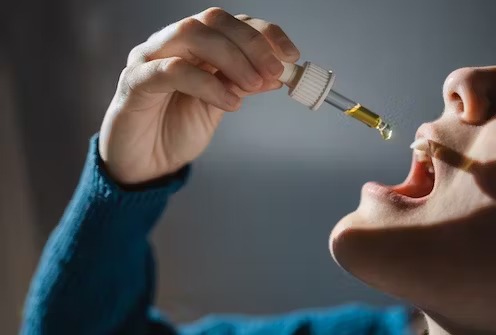

Since 2018 when the UK parliament passed legislation legalising CBD, the non-psychoactive component of cannabis, sales of CBD-related products have skyrocketed. Today, you can buy CBD oil, CBD vape pens, CBD coffee, CBD muffins to go with your CBD coffee … CBD everything. And these products are often sold with various vague promises of increased wellness.
As CBD, in this context, isn’t a medicine, it isn’t regulated by the UK’s drugs regulator but by the Food Standards Agency (FSA). In 2020, the FSA recommended that daily consumption of CBD should not exceed 70mg. Now, the FSA and Food Standards Scotland have reduced this limit to 10mg – roughly four drops of 5% CBD oil.
To be clear, 10mg is the advisable safe limit. You won’t be arrested if you consume more than 10mg a day, but the agency warns that there may be long-term health effects if you ignore the advice – namely, harm to the liver and thyroid.
CBD’s effects have been tested on a range of ailments, from schizophrenia to anxiety, with mixed results. When benefits have been evident, it is usually at a much higher dose – about five times the previously recommended maximum intake.
The new 10mg recommended limit has nothing to do with the effectiveness of the drug at this dose – because there is no proven effect. The shift to a lower recommended dose comes after several studies have indicated that CBD may not be as harmless as previously thought.
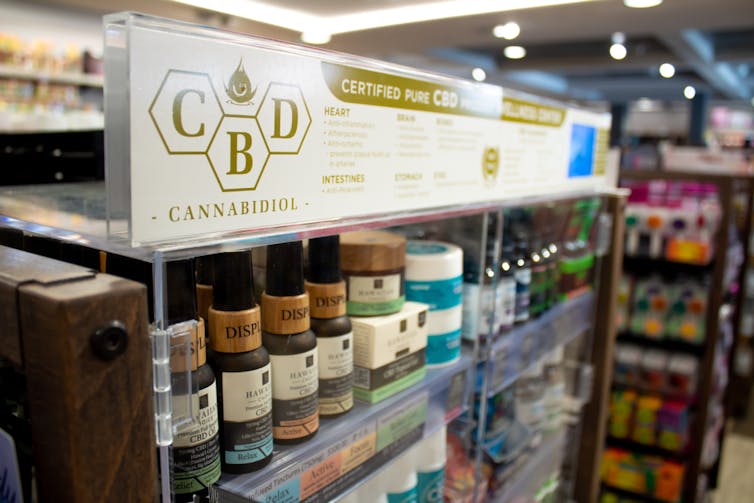
The world is saturated with CBD products. Kevin McGovern/Shutterstock
To determine how harmful a substance is – or rather, what’s the highest safe amount a human can consume in a given time – scientists test it on animals and then apply a “correction level”.
For example, if, in a study using rats, a dose of 100mg per kilogram of body weight is said to be the highest dose where no harms are observed, that would mean for a 70kg human an intake of 7g daily.
There are, however, differences in metabolism between species, with humans being potentially more susceptible to harm.
Accidentally boosting the dose
It is worth noting that seemingly harmless foods, such as grapefruit, broccoli and a well-done steak,can all interfere in the metabolism of certain drugs. It is already known that rifampicin, a widely prescribed antibiotic, can interfere with CBD metabolism. Other drugs need to be monitored closely for potential interaction.
There is also an increased risk of getting too high a dose when taking CBD with other medicines, such as ketoconazole (a drug to control fungal infection), and even an increase in absorption when CBD is taken with fatty food. That is why it is not uncommon for drug safety experts to apply a 400-fold correction factor to the previously calculated values. That would bring the allowed intake down from 7g a day to just 17.5mg a day.
Using several animal studies of CBD that indicated similar values and the correction factors, erring on the side of caution, the new recommended level was recently made public. That is the job of public agencies: on the best evidence possible, to indicate whether a component can do what it’s supposed to and not cause harm when doing so.
It is important to highlight that the FSA’s recent announcement is not a ban. You can still buy drinks infused with CBD that surpass the new daily limit in a single serving. However, any new product will need - as before - to undergo approval by the FSA, which may be harder with this new limit. Ensuring safety, especially for a substance that seems to bring very little benefit in return, is rightly the agency’s priority.







