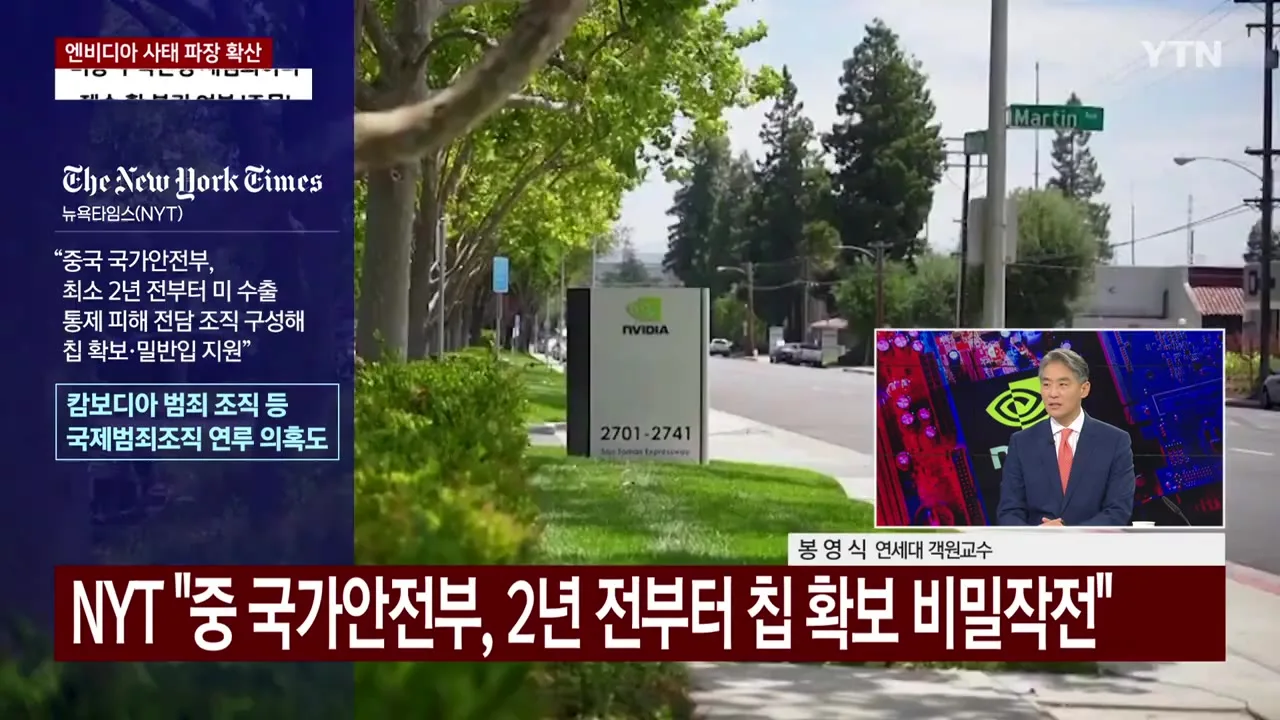
Suspected smuggling of Nvidia's advanced chips has exposed a gap in U.S. export controls that could take years to address, Yonsei University professor Bong Young-shik said.
The U.S. government has no clear answer to how it can close the gap, Bong said in an interview on YTN's News UP published Nov. 22. He said officials were discussing whether to make semiconductor companies responsible for illegal exports under rules modeled on banking law.
Bong said the Financial Times had reported allegations that China's Ministry of State Security had worked for at least two years to obtain advanced Nvidia chips while evading U.S. controls. Cambodia-based Prince Group, which he described as a criminal organization, acted as an intermediary, he said.
China has denied the allegations, Bong said. He said demand for the chips in China and their value on the black market made the trade difficult to stop.
The Treasury Department wants Nvidia to account for how the alleged violations occurred, Bong said. He described a difference within the administration, with the Commerce Department and President Donald Trump favoring flexibility in chip sales to China.
Bong said banks bear responsibility when they are involved with illicit funds, even though the government conducts the initial investigation. He said a similar approach was being discussed for semiconductor companies.
China's supply of rare earths, minerals used in manufacturing, also gives Beijing a bargaining tool in its trade relationship with Washington, Bong said. He said tighter U.S. chip controls could prompt China to restrict exports of those materials.
Bong said Treasury Secretary Scott Bessent's position was that Nvidia should establish who was responsible for decisions that led to the alleged breaches. He said questions about the company's decision-making would remain even if Jensen Huang returned to lead it.
On North Korea, Bong said a U.S. proposal did not amount to recognizing the country as a nuclear-armed state. Washington had offered to avoid discussing its nuclear weapons and consider a declaration ending the Korean War, he said.
North Korea wants formal recognition as a nuclear-armed state, Bong said. He said its ties with Russia and China had strengthened its position, leaving it less inclined to accept a summit without assurances that its conditions would be met.
Bong said he expected North Korean leader Kim Jong Un to meet Trump within the remaining two years of the U.S. president's term. The timing and terms of any meeting remain open.