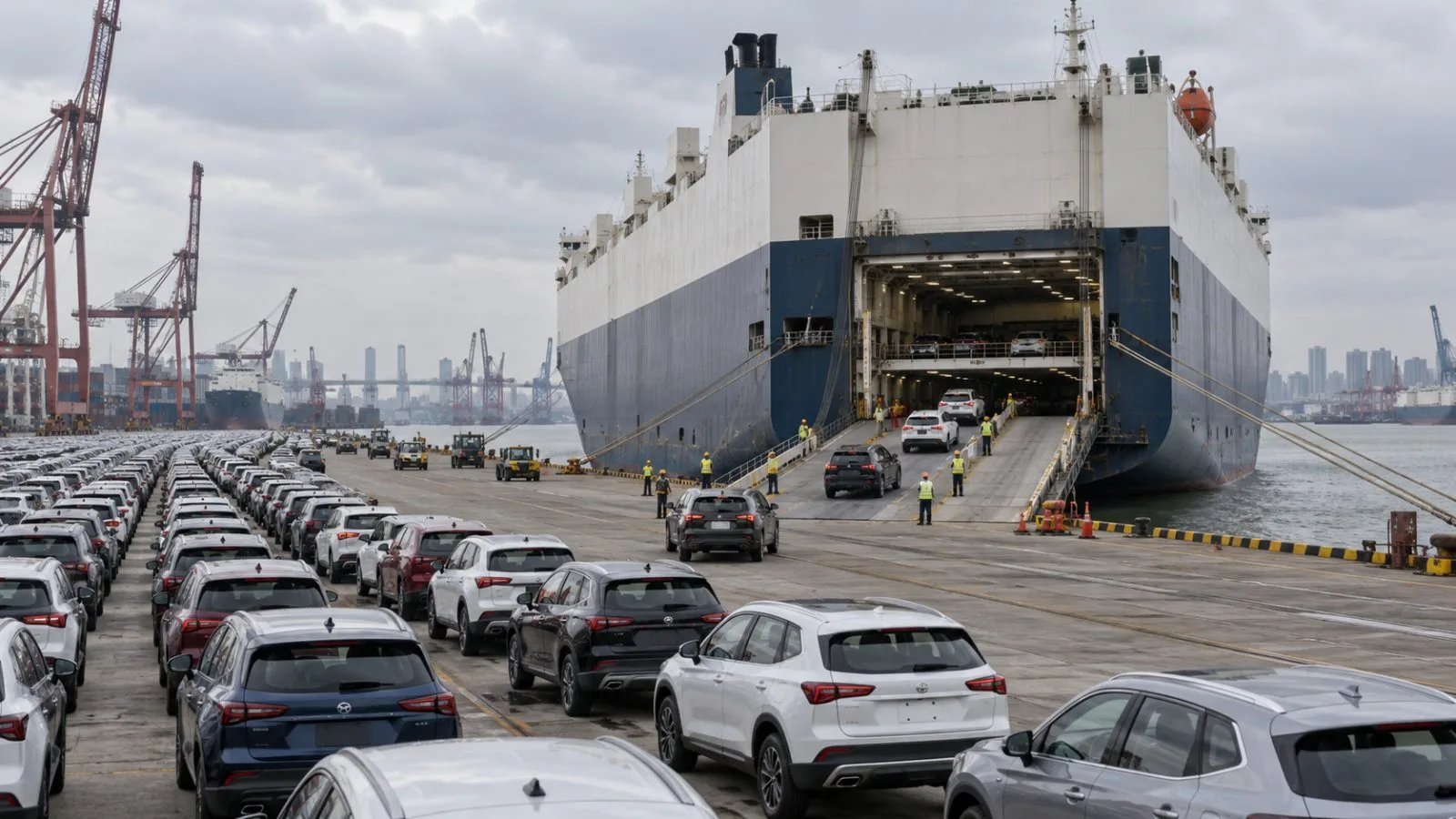
China's automakers sent more complete vehicles overseas in September as domestic passenger-car retail fell and new data showed weaker factory use and profits, underscoring the uneven state of the industry.
The Ministry of Industry and Information Technology (MIIT), citing the China Association of Automobile Manufacturers (CAAM), said China exported 1.053 million complete vehicles in September, up 61.4% year over year. New-energy vehicle exports reached 571,000, a 157.2% increase from a year earlier.
At home, passenger-car retail sales totaled 1.618 million, down 28.0% year over year, the China Automobile Dealers Association's passenger-car market branch reported. Retail sales of new-energy passenger cars fell 16.7% to 1.084 million, but they still represented 67.0% of the total, up 9.1 percentage points from a year earlier. MIIT's separate tally showed 1.823 million new-energy vehicle sales, up 13.6%; it covers a broader measure than domestic passenger-car retail.
The association also reported 917,000 passenger-car exports in September, up 73.7% from a year earlier. The 917,000 figure combines complete vehicles with knock-down kits; the association said these exports accounted for 36% of passenger-car manufacturers’ sales, versus 19% a year earlier.
The National Bureau of Statistics (NBS) reported that capacity utilization across automobile manufacturing was 66.2% in the third quarter, down 7.1 percentage points year over year. The NBS utilization figure covers the auto manufacturing sector as a whole, rather than EV plants specifically. From January through August, automobile-manufacturing profits fell 16.0%, while revenue rose 2.9% and costs increased 4.0%.
NDTV reported that EV price cuts can reduce buyers' costs while narrowing the margins automakers retain on each sale. Price competition has also drawn regulatory action: the State Administration for Market Regulation (SAMR) issued auto-industry pricing guidelines in February, and MIIT and SAMR said they interviewed automakers suspected of irrational competition on June 11, urging compliance with pricing rules and stronger product-quality controls.
The Wall Street Journal reported that AlixPartners counted 143 EV brands with at least one sale in China by year-end 2025. The Journal also cited Tu Le, managing director of Sino Auto Insights, who said local officials have reason to prioritize tax revenue and jobs, helping explain government support for the industry. In a June forecast, AlixPartners said seven members of its 30-company Chinese new-energy vehicle manufacturer cohort active in 2025 would break even by 2030.
The association's October outlook anticipated stronger retail traffic, pointing to auto shows, local subsidies and automaker promotions.