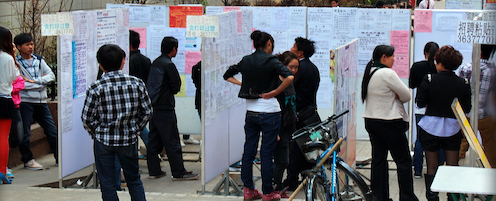
Youth unemployment is a global problem, but in China the rate - 21.3% - is particularly alarming, not just because it’s high, but because it could affect other economies and geopolitical relations.
The release of the rate, which more than doubled the pre-COVID rate of May 2018, coincided with China’s National Bureau of Statistics announcing it would no longer report age specific data because it needed to “improve and optimise labour force survey statistics”.
Youth unemployment is a complex issue, but even more so in China as a result of government policy and society’s expectations.
Under the Hukou system, households in China are required to register, and authorities then determine where they live and work and which public services they can access.
The system often stops rural residents taking advantage of urban opportunities, which can limit their work prospects.
The stress and uncertainty experienced by this demographic is only worsened by the expectations that come with being the only child in the family as a result of China’s one child policy, which was abandoned only seven years ago.
The “Ant Tribe” phenomenon
The term “Ant Tribe” was coined in 2009 by sociologist Lian Si to describe highly educated young people stuck in low-paying, temporary jobs that hinder skill advancement.
These young people can’t accumulate social capital, leading to a negative cycle that’s hard to escape. This diminishes their return on their investment in education and highlights a breakdown in the career ecosystem.
The “Ant Tribe” phenomenon is more than just a sign of a flawed economy. It also reveals a deeper emotional and psychological issue. Being over educated and underemployed causes significant emotional trauma, including anxiety, depression and hopelessness.
This emotional toll is further complicated by societal shifts such as the “lying flat” movement and the rise of “full time children” in China.
These trends challenge traditional markers of success and redefine family expectations, adding another layer to the psychological complexities faced by the younger generation. The impact can be long-lasting, leading to a less productive and innovative workforce.
Weaknesses in the education system
Despite rapid expansion in higher education, a disconnect exists between university curricula and job market needs.
Programs often favour theory over practical skills, leaving graduates ill-equipped for work. For example, engineering students might focus on equations and theories but miss out on real-world applications such as internships.

Overqualified candidates flood the jobs market, forcing many to return to study. Shutterstock
Additionally, the market faces a glut of overqualified candidates, especially in the technology, finance and healthcare sectors. This imbalance drives many towards further studies.
In 2023, a total of 4.74 million students took the postgraduate entrance exam, a staggering 135% increase on the 2.01 million test takers in 2017. This cycle exacerbates youth unemployment and underemployment.
The wider impact
The ripple effect of China’s youth unemployment crisis is not to be underestimated. Drawing on warnings from UNICEF, high unemployment rates can lead to civil unrest, especially in nations with a large youth population.
The Chinese Communist Party has long maintained its authoritarian approach by securing a social licence based on economic stability and prosperity.
If rising youth unemployment erodes this licence by fostering political disengagement or radicalisation, China could experience a significant internal power shift.
In a globally connected world, such turmoil could spill over into international relations. Civic unrest can make a country less stable and thus less attractive to foreign investment, especially among nations with close economic ties to China.
Such an internal upheaval also threatens to destabilise supply chains globally, given China’s pivotal role in global supply chains.
Historical examples such as the Arab Spring and Brexit show internal dissatisfaction and social unrest can have ripple effects on a country’s international relations.
The Arab Spring led to the overthrow of multiple governments, created regional instability, influenced global oil prices, and necessitated the resetting of foreign policy by Western countries.

Instability in Britain caused by Brexit led to changes in foreign policy. Shutterstock
Similarly, Brexit impacted global trade agreements, led to political realignment, and caused the European Union to reconsider its future direction, affecting its collective foreign policy.
While youth unemployment is a global dilemma, the extent of the problem in China and its potential broader impact on interconnected economies means we can’t afford to ignore it.
What can China do to solve the problem?
China can find policy inspiration from successful initiatives in other countries, such as Germany’s dual vocational training system. This system ensures students are both academically prepared and practically skilled, better aligning education with labour market demands.
Addressing the urban/rural divide is equally crucial. By offering financial incentives including tax breaks and grants, China could promote job growth in rural areas. Australia and the United States have adopted similar models to attract healthcare workers to less populated regions.
China also needs to do something to reduce the emotional toll of chronic unemployment which worsens the longer graduates are out of work. Post-COVID, the issue is exacerbated, with 40% of Chinese youth reported to be susceptible to mental health challenges.
This is where mental health services such as those available in Australia that are tailored to young people could help. Besides benefiting the individual, these programs contribute to a more engaged, productive workforce essential for national well being.
The precarious nature of the gig economy can further deepen the unemployment crisis. Some European countries such as France and the Netherlands consider gig workers employees and offer social security benefits. A similar model could be implemented in China, providing benefits such as health insurance and retirement plans.
Finally, the scale and complexity of youth unemployment requires a multi-pronged approach that extends beyond national borders.
Countries should actively share successful employment strategies and cooperate on international initiatives to create job opportunities for youth. Collaboration is the key to developing a globally stable, productive young workforce.
Investing in young people isn’t just good policy. It’s a moral imperative for global stability and shared prosperity.