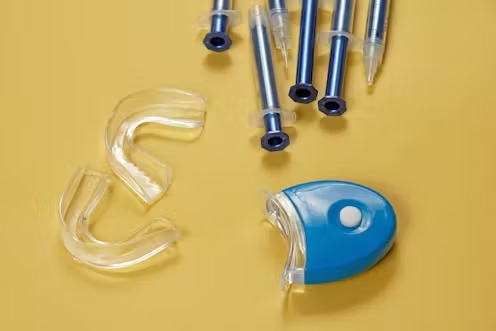
UK Trading Standards has recently found that up to 90% of home-use teeth-whitening kits shipped through the mail might be unsafe.
It is unlawful in the UK for home-use teeth-whitening kits to contain more than 0.1% hydrogen peroxide, the chemical most commonly used to bleach teeth. Whitening products that release between 0.1% and 6% hydrogen peroxide can only be supplied by a dentist.
If you want to use a teeth-whitening kit at home, it’s a good idea to speak to your dentist first. That way, he or she can advise you on the appropriate strength of the bleaching agent. They can also check that you don’t have untreated tooth decay, advanced gum disease or thinning enamel – things that could make teeth whitening a bad option for you. They can also monitor the whitening process to ensure nothing goes awry.
Teeth whitening can be undertaken at your dental practice, achieving similar whitening results, but over a shorter time frame. Your dental team can apply a higher strength of bleaching agent at the chair side, and they can manage any potential unpleasant side-effects of tooth whitening, such as increased sensitivity.
Some home-use teeth whitening kits bought online have been found to contain as much as 300 times the safe, legal limit, reaching dangerous levels of hydrogen peroxide of around 30%.
Such a high concentration of hydrogen peroxide could damage the surface enamel of the teeth. It can also irritate the gums and soft tissue in the mouth. The higher the dose, the more damage it can cause.
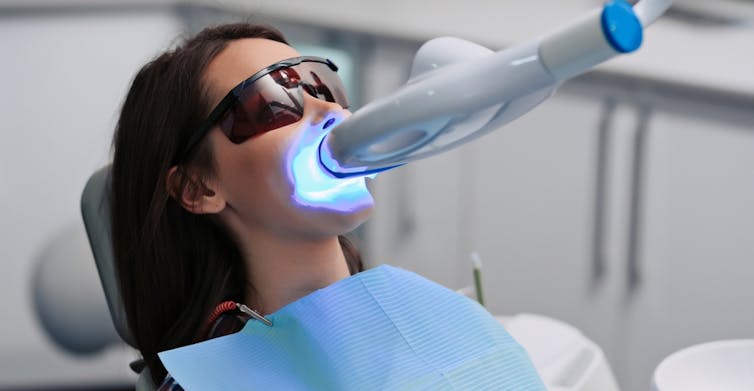
If you’re going to get your teeth whitened, it’s best to have it done by your dentist. JJ-stockstudio/Shutterstock
Too white
Teeth that are over-whitened are likely to become more translucent and appear greyish. Over-whitened teeth are also susceptible to enamel erosion, which is serious and irreversible. The oxidising effect of hydrogen peroxide can also be detrimental to the soft tissues in the mouth if the bleaching is overdone.
Some online products have been found to contain other hazardous chemicals, including toxic or banned substances that can severely burn gum tissues or irreparably damage teeth.
A common ingredient, sodium hexametaphosphate, found in bleach, can potentially cause skin irritation and a slower-than-normal heart rate, called bradycardia.
Another ingredient, carbopol, which stabilises and thickens the whitening formula, can lead to eye swelling and increased tear production if they are used in abundance in susceptible people, such as those who have allergies.
Buying teeth-whitening products online may be convenient and cheap. Yet with multiple chemical ingredients listed on the label, it’s not always easy to tell whether the dose of hydrogen peroxide will be at a harmful level. The reason is that other chemicals, such as carbamide peroxide and zinc peroxide, can boost the concentration of hydrogen peroxide.
Except for the use of a very low dose of hydrogen peroxide (0.1%), as in whitening toothpastes, people are strongly advised to consult their dentists before they buy a teeth-whitening kit online.