Something unusual seems to be happening with dengue, a potentially fatal mosquito-borne viral disease found across swathes of tropical Africa, Asia and the Americas. As with most infectious diseases, the number of cases tends to rise and fall over the years as epidemics come and go, but recently changes seem to be afoot in how dengue is behaving.
Not only is the number of new infections steadily rising around the world, but outbreaks are becoming larger and less predictable. For example, 2019 saw the greatest number of dengue fever cases ever recorded – almost twice as high as the previous year. And in July 2023, there were a record number of deaths from the disease in Bangladesh.
Most people infected with dengue will suffer from flu-like symptoms, ranging from relatively mild to very unpleasant, with fever, headache and joint pain.
In more severe cases, though, blood vessels can become damaged by the virus, allowing blood to leak into the surrounding tissues. This condition, known as dengue haemorrhagic fever, can produce bruising, and bleeding from the nose and gums. It can ultimately lead to organ failure and death as the body slips into shock.
The principal agent, or vector, in the transmission of dengue, is the Asian Tiger mosquito Aedes aegypti, although its cousin Aedes albopictus is also capable of spreading the virus.
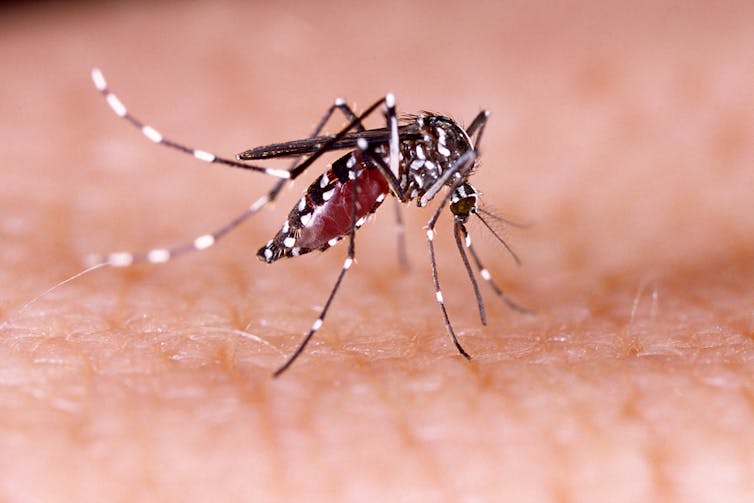
Aedes aegypti mosquitoes are the main spreaders of dengue. Tacio Philip Sansonovski/Shutterstock
While Aedes aegypti is essentially a tropical mosquito, it is a very adaptable insect. In recent years, it has expanded its range out of the tropics into southern Europe and to several states in the US, including Florida, Hawaii, Texas and Arizona.
All mosquitos need water to breed, but another thing that has helped in its migration is its ability to use even the smallest of water containers to do so, something as small as a discarded plastic bottle cap will do.
Despite this capability, it is usually the lack of breeding sites that caps the number of mosquitoes in circulation and therefore their ability to spread the dengue virus. But in Bangladesh this year the rains arrived early and, coupled with an unusually high temperature and humidity, this led mosquito numbers to surge.
Because a large proportion of the population of Bangladesh spends a great deal of time outside and tends to have houses that are relatively simple for mosquitoes to enter, it took little time at all for dengue to take hold and then explode.
Although no one is certain about what’s driving the increase and instability of dengue, climate change may be contributing as much of the world is getting both warmer and wetter.
Fortunately for most high-income countries, even areas within the current range of Aedes Aegypti, climate change will probably not lead to any major outbreaks simply because people spend so much of their time indoors and out of the reach of mosquitos. It takes a certain amount of biting pressure within a population to sustain transmission.
WHO warns of dengue spread to new places
However, a new report by the World Health Organization’s chief scientist suggests that the disease may still be able to establish itself in parts of Europe, the US and Africa where it has previously been absent.
Something that is also likely to be seen more often is what happened recently in Bangladesh repeats itself across similar middle- and low-income countries where the opportunity for mosquitoes and people to mix is greater.
The solution is likely to be an affordable and effective vaccine. Indeed, the WHO has recently recommended the Qdenga vaccine for children living in areas where the infection is a major public health problem.
However, dengue is not the only concern as there are a variety of other mosquito-borne infections that kill around a million people every year. Diseases like chikungunya, yellow fever and Zika virus are all transmitted by Aedes aegypti.
An increasingly warmer, wetter and less reliable climate is therefore probably going to be the precursor for many more – and less predictable – mosquito-related disease outbreaks, and ultimately deaths, in the future. As with most other life-threatening communicable diseases, it is once again the poorest communities in the global tropics that will have to bear the brunt of this.