


 AI is supercharging money scams – here’s what you can do to protect yourself
  1 in 3 uni students experience serious financial hardship. Could concession cards for all help?
  ‘Buy now, pay later’ doesn’t feel like debt. For young people, that can be a big problem
  Synthetic data could ease people’s concerns about privacy breaches. But who gets to create it?
  Big AI wants to slow down AI research. Is it a safety pause or a strategic retreat?
  Physicists zoom into the birth of cosmic rainstorms with new CERN study
  Who should own the knowledge that underpins AI technology?
  Unsustainable – or manageable? We don’t yet know how data centres will impact Australia’s environment


 Add as a preferred source on Google
Changes in economy occurs first at micro levels (companies, production of goods), which then gets reflected in macro levels (GDP, inflation).
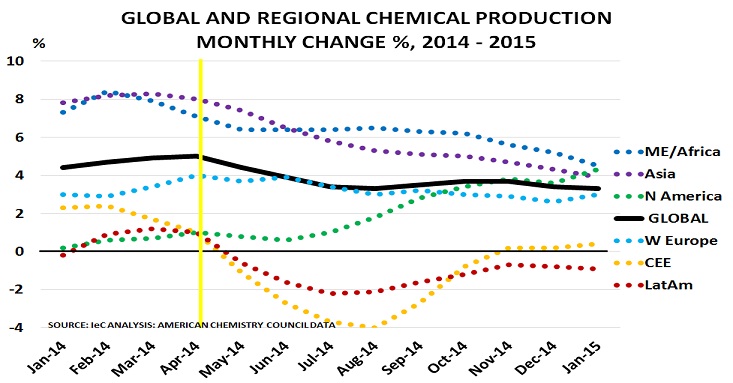
- In lot many ways, growth in chemical companies viz. production is a leading economic indicator and the current condition is expressed nicely in a chart from ICIS, a market intelligence provider in chemical and fertilizer industry.
- Global growth peaked in January 2014 to 5.1% have lagged since then and currently at 3.3%
- Growth in North America has increased significantly from 0.1% in January 2014 to more than 4% as of now. This reaffirms the return of growth in US.
- Growth in Middle East has slowed from 8% in February 2014 to 4.5% as of now.
- Growth in Asia slowed to 3.9% from its peak around 8% in early 2014.
- Growth has remained subdued across Euro zone though it shows some signs of recovery. In central and eastern Europe growth slumped to - 4% however started recovering since then.
- Latin America continues to experience negative growth.
Analogy -
- Global recovery would take longer despite strong US economy. Central banks are to keep monetary policies ultra-loose.
- However as situation improves across Euro zone and ECB vows to keep monetary policy loose, the equities might gain further.
- Diverging growth in Asia, Middle East and Latin America compared to US, might keep the dollar stronger against the currencies of these regions.







