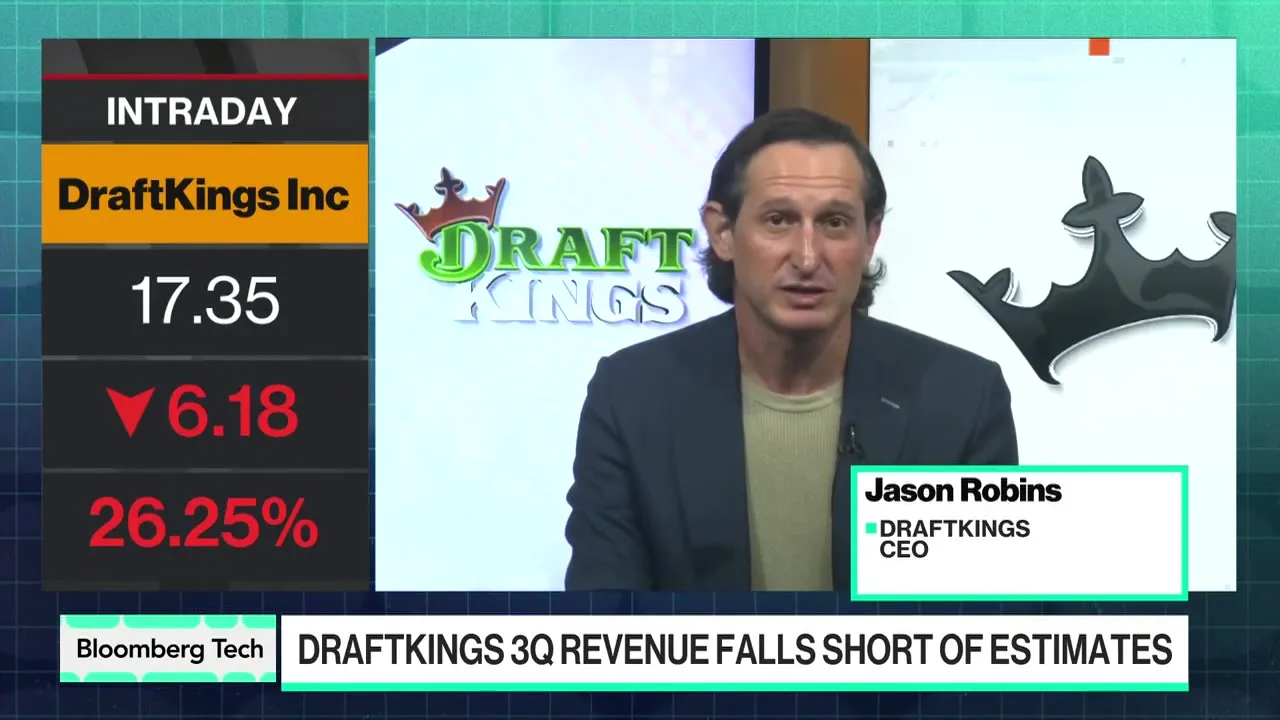
DraftKings expects customers already acquired through its prediction market push this year to generate $350 million in gross profit in 2027, Jason Robins, the company's chief executive, said.
The spending has reduced earnings this year, but Robins said the returns justified the investment. He spoke on Bloomberg Technology in an interview published Nov. 6.
DraftKings' prediction market investment this year reached $650 million to $700 million, compared with an earlier expectation of $200 million to $300 million, Bloomberg reported. Prediction markets let customers trade contracts tied to the outcomes of events.
Most of the money went toward attracting customers rather than building the offering, Robins said. The company increased spending after seeing how quickly customers acquired this year were expected to repay the cost of attracting them.
“We were gonna follow the data and spend more,” he said. “I think it was a lot more than people thought.” He said the investment would prove the right decision over the next year or two.
Asked whether spending could rise further, Robins said he hoped investors did not expect another increase. The gross profit forecast covers customers already acquired, excluding those the company expects to attract during the rest of the year.
He compared the approach with spending that contributed to losses in 2022 and early 2023. Customers acquired during that period now produce cash flow in the company's business outside prediction markets, he said.
Regulatory uncertainty makes the latest investment different, Robins said. Even if sports contracts disappear, he expects the company to recover the cost of acquiring those customers in roughly four years, against its usual three-year target.
Robins declined to predict whether sports contracts would survive a legal challenge. He said customers could also use contracts unrelated to sports and other company products, including lottery offerings and Pick Six.
He expects customers acquired in 2026 to repay their acquisition costs before the projected date of a Supreme Court decision. He gave no date for that decision. Customers acquired in 2027 would take a couple of years beyond that point, though the court timetable could slip.
Robins said DraftKings had positioned itself to compete whichever way the court ruled. He said traditional prediction market operators depended on sports contracts surviving, while gambling competitors that had made less progress in prediction markets depended on their removal.
“We are not dependent on an outcome that we have no control over,” he said. He did not predict the legal outcome or commit to a spending ceiling.
Turning to elections, Robins said prediction markets attracted traffic but limited trading. Larger markets with enough trading probably reflected sentiment, he said, while small trading volumes could shift prices in smaller markets.