Dungeons & Dragons has a longstanding appeal as a role-playing game – or as some players prefer to call it, a storytelling medium. But retaining users in the face of competition is far from easy, despite a recent resurgence thanks to Netflix hit Stranger Things, the uptake in remote activities sparked by COVID lockdowns and an upcoming film adaptation.
To maintain its competitive edge, the owner of Dungeons & Dragons – Wizards of the Coast – is proposing changes to the ownership of the game’s intellectual property and the way it makes money.
The original Dungeons & Dragons gaming licence meant that players could create unique content, such as story lines or maps, which would be developed over several sessions (sometimes years) of play.
The original licence encouraged “dungeon masters” (the players responsible for guiding groups through Dungeons & Dragons sessions) to lead players on creative adventures and to share their story lines with a wider community.
The enduring appeal of Dungeons & Dragons has been the ability to pick up adventures written decades ago and play them while adding unique twists. This could mean a steampunk take on an official story line, for example, or changing the setting from a medieval fantasy to outer space.
Any time these creative versions of the game were shared or produced for profit under the original licence, Wizards of the Coast went uncompensated.
Its original Open Gaming License, published in 2000, ran to around 900 words, and is basic compared to most other game licences.
The new, leaked Open Gaming License Version 1.0a in contrast, runs to 398 pages, and seeks to introduce a set of rules controlling – in the words of Dungeons & Dragons staff – the way large businesses “exploit” the company’s intellectual property.
It’s not ‘just a game’
The owner of Dungeons & Dragons first made changes to the Open Gaming License in late December 2022. This proved hugely controversial, driving some players to leave the game entirely, objecting to this attempt to generate greater revenues by claiming rights over the creativity of Dungeons & Dragons players.
Under the terms of the revised Open Gaming License, the characters developed and storylines created by players could become the property of the game, rather than the community who made them.
Players who have particularly lucrative content creation activities could also now be responsible for compensating Wizards of the Coast for a share of their profits.
Worse still, the new Open Gaming License limits the creation of new content, restricting both play and profit. Players who want to add their own characters and stories have a lot less incentive under the new licence. While the licence lets players create their own storylines and characters, it also renders them responsible for reporting any revenue they make off them.
The new licence imposes “sharing” requirements – what is created by a player becomes licensed to Wizards of the Coast to profit from too. If you created a new dwarf character, for example, it would no longer be yours. You agree by playing the game that Wizards of the Coast can both use it and commercialise it for profit.
This is especially worrying for players who rely on their creations for a revenue stream, such as Dungeons & Dragons influencers.
While these changes may sound restrictive, Wizards of the Coast is clear that little is changing for most players. The reality is that the alterations to revenue reporting will affect only those making over US$750,000 (£613,000) a year from the game. This clarification highlights the distinction between when Dungeons & Dragons is “just” a game, and when it is not.
Aligning Dungeons & Dragons with other games
While controversial, this move aligns Dungeons & Dragons more closely with other interactive games.
For most games, End User Licence Agreements (EULAs) include clauses outlining that users and players have no rights to any of the intellectual property. Commercialisation of game-related content is therefore usually quite difficult.
The changes also reinforce that Wizards of the Coast is stepping up commercialisation and seeking to protect its intellectual property – steps likely to be reflected in developments elsewhere, including a forthcoming Dungeons & Dragons-themed Lego set.
With films and a TV series to follow, it seems that the Open Gaming License revision is the first step in taking control of revenue streams.
Hard to read but easy to ignore
Gamers often invest heavily in the titles they play without realising that the companies who develop the games are the ultimate owners. Licence agreements are rarely read.
Game licences are hard to read, easy to ignore and often painful for those they seek to control. Handled badly, they can cause more harm than good and destroy the relationship a game owner has with the community it relies upon.
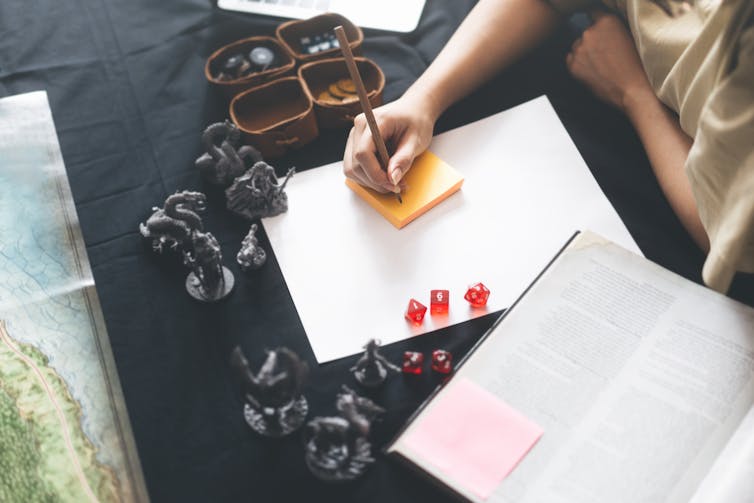
A typical Dungeons & Dragons player set up. dodotone / Shutterstock
Without the Open Gaming License first published in 2000, Dungeons & Dragons would probably not have experienced the loyal following of its player community. The attraction of the game – and the licence – lies in the ability to experience it through your own imagination.
The unprecedented alteration in the Open Gaming License signifies that Wizards of the Coast has put profits before players. The owner of Dungeons & Dragons acted to protect its own interests, but in doing so has damaged – perhaps irreparably – the relationship it has enjoyed with its player community.