


 Mike Rogers Calls for End to US-Canada Tariff War
  Iran Tanker Attacks Surge as Hormuz Oil Flows Near Prewar Levels
  Fed Minutes Signal Another Rate Hike by Year-End
  China Shuts 670 Banks as Bitcoin Eyes Financial Risks
  Kalshi Withdraws PEPE Perpetual Futures Filing
  Cardano Price Surges 10% as ADA Targets $0.30
  RBI Raises Repo Rate to 5.50% in Hawkish Shift on Inflation Risks
  U.S. Government Moves Over $100M in Bitcoin and BNB
  Bitcoin Bull Cycle Still Early as XRP, NEAR Consolidate
  Zcash Privacy Demand Rises as AI Exposes Bitcoin Transactions
  S&P 500 Hits Record High as AI Rally Lifts Wall Street
  Gold Prices Rise as Dollar Weakens, Treasury Yields Ease
  BlackRock’s Rick Rieder Favors Bonds Over Stocks as Treasury Yields Surge
  Fed Unveils Stablecoin Rules Under GENIUS Act


 Add as a preferred source on Google
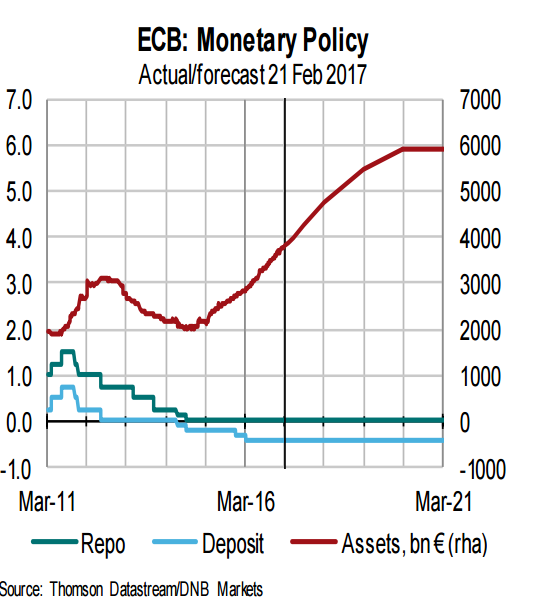
The European Central Bank (ECB) kept interest rates unchanged, including its €2.3 trillion bond-buying program but presented a brighter view of the eurozone economy. ECB president Mario Draghi sounded more upbeat about the effectiveness of the monetary policy. The central bankers acknowledged that the economic and inflation situation for the euro zone has improved.
The slight change in rhetoric from the ECB yesterday has taken a lot of negativity out of sentiment. The notably more upbeat tone in Mr Draghi’s assessment of economic prospects for the Euro area, even though there have been no corresponding upward revision to GDP growth forecasts in the ECB’s new projections suggests the ECB might slowly start to take small steps towards reconsidering its policy stance.
The ECB deleted from its communiqué the sentence stating that it was ready to use “all the instruments available within its mandate” in order to achieve its objectives. However, Draghi did everything to stop triggering expectations of rate hikes. He noted that the ECB has not dropped the option of another rate cut from its forward guidance. Draghi stressed that core inflation still hasn't risen, and central bank isn’t entirely convinced of a self-sustaining pick-up in inflation and still sees underlying inflationary pressure as weak.
The new ECB projections show a slightly firmer trend in ‘core’ inflation in 2018 and 2019 than previously envisaged. This brings core inflation to 1.8 percent in 2019, an outturn that is probably in line with the ECB’s definition of price stability. GDP growth for 2017 and 2018 are marginally stronger at 1.8 percent and 1.7 percent respectively. However, 2019 is still seen at a more modest 1.6 percent implying a slowing trajectory for economic growth in coming years.
"We suspect that this element of the forward guidance will be deleted in June. Furthermore, we expect gradual further tapering of QE from January 2018 with the asset purchases concluded in the second half of that year. And that would allow a first hike in the Deposit Rate in December 2018, with the Refi Rate not increased until 2019." said Chris Scicluna at Daiwa Capital Markets.
EUR appreciated by almost 1 percent against USD, but the reference to keeping the door open for further rate cuts is likely to have capped EUR appreciation. EUR/USD is extending gains on Friday, was up 0.32 percent at 1.0609 at 1150 GMT. The near-term resistance for the pair is seen around 1.06270 -1.06400 and any break above will take the pair till 1.06996 (61.8% retracement of 1.08288 and 1.04936)/1.07140. On the lower side, any weakness can be seen below 1.04900 and break below will drag the pair till 1.04530/1.03450 (Jan 1st 2017 low).
FxWirePro's currency strength index at 1150 GMT was as follows: Hourly EUR Spot Index was at 109.288 (Highly bullish) and Hourly USD Spot Index was at 83.4352 (Bullish). For more details on FxWirePro's Currency Strength Index, visit http://www.fxwirepro.com/currencyindex.







