
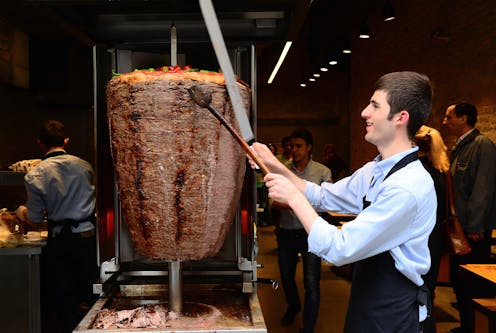
In a recent Amazon poll among its employees in European countries to mark the European football championships, the kebab appears as their favourite food, with the English beans on toast coming a distant second.
More than half of the 75,000 respondents said they partake at least once a week. And while even kebab aficionados will admit it’s hardly haute cuisine, its fan base cuts across all classes. It was reported, for instance, that one of the first things the global superstar Taylor Swift did when touching down in London to perform was to place an order with her favourite kebab shop.
How representative the poll is for the population at large is, of course, up for debate. What is certain is that the kebab, in one of its many iterations, has undoubtedly been a staple in the diet of the multitude of football fans travelling to Germany for the Euros. Aside from the fact that it is a popular snack – often late at night – in many countries, its modern variant is believed by many to have been invented in Germany.
How can this be? And why, if that is the case, is it often referred to as Turkish kebab? As someone who is fascinated by Middle Eastern cuisine and tries to recreate medieval Arab dishes, the story of the kebab and the complexity of its development and movement across the centuries, is a wonderful story of cultural exchange.
But what, exactly, is a kebab? In its most basic form, it is skewered and grilled meat slices, and thus a distant relative of the Indonesian satay or the Greek souvlaki. The birth of the kebab has been lost in the mists of time, but one plausible theory is that it was a quick and easy way of roasting meat by soldiers, using their swords as skewers.
The word, itself, comes from the Arabic kabab and it is in the rich medieval Arabic culinary literature (9th-15th centuries) that we find the first recipes to make kebabs, the oldest dating from 13th-century Aleppo. Before roasting over a low fire, or hung into a clay oven (tandoor), the meat (usually lamb) would be seasoned (for instance with sesame oil, coriander, garlic and sometimes also with rose water). The same Syrian source includes a variation involving alternating meat with sheep’s tail fat on the skewer.
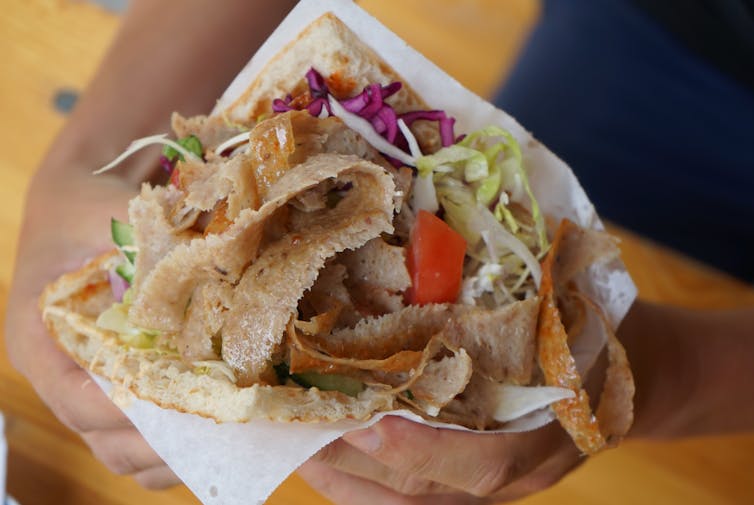
Great for a post-match snack: the modern doner kebab. Sahara Frost/Shutterstock
Besides frequently gracing the tables of the elite, kebabs were a popular market food as well. Intriguingly, however, the cookery books only use the generic word for “slices or strips of meat” (shara’ih), rather than kabab. Other medieval sources equate the word with a dish known by the Persian word tabahaja, denoting fried meat slices, usually with the addition of a sauce.
Early Ottoman (Turkish) cuisine was much inspired by the Arabs and the kebab quickly gained in popularity, even among sultans, though it had to be prepared in a dedicated kitchen away from the royal quarters, due to the smell.
As the Ottoman empire rose and spread, so did the kebab, and became known as şiş (Turkish for “skewer”) kebab, usually written as shish kebab in English. The earlier Syrian variant with tail fat (or suet) being skewered alongside the meat would become the döner kebab, a word meaning “turn” in Turkish, in reference to the rotating spit, which originally was horizontal but in the 19th century was flipped upwards, as a way of saving space. It is this rotisserie method that is such a familiar sight in so many countries today.
In Greece, it became known as gyros, also meaning “turn”. In an interesting case of reverse linguistic borrowing, the equivalent in the Arabic-speaking world is now called shawarma, an Arabised form of the Turkish çevirme, also meaning “turn(ing)”.
Fast-food origins
But it would take until the 20th century before someone came up with the idea of putting doner kebab into a flatbread with some salad vegetables and sauce added for good measure, thus giving birth to the modern variety. It is thought that this happened in the early 1970s in Germany, in what was then west Berlin, where a Turkish immigrant, Kadir Nurman, started the trend (this story is disputed, needless to say).

Kadir Nurman is widely thought to have invented the modern kebab ‘sandwich’. alianza de imágenes / dpa, CC BY-NC-SA
From there it spread rapidly and, in the process, emerged in numerous guises, notably in terms of the meat used, with chicken and beef alongside lamb or, in the case of the Greek gyros, pork.
The Turks are responsible for another variety that today vies with the others for supremacy, the kofte kebab (grilled skewers of minced meat), though the word comes from the Persian kofta, “pounded meat”.
As the above poll shows, the kebab continues to go from strength to strength, even if it has been grappling with an image problem for being a calorific fast food. But as football fans – and everyone else, for that matter – tuck into their German-Turkish kebabs, they might take solace from the advice of 11th-century Baghdadi physician, Ibn Jazla who reassures us that kebab is the most nutritious of all meat roasts, though he warned that it can be harmful to those with a weak stomach.


