


 Wall Street Ends Mixed as Investors Await CPI and Bank Earnings
  RBA Signals More Rate Hikes as Inflation Risks Rise
  S&P 500 Rally Masks Losses for Over 40% of Stocks in 2026
  Nasdaq Falls as Oil Prices Surge Ahead of Bank Earnings
  Asian Stocks Plunge as AI Chip Selloff Hits South Korea and Japan
  RBI Raises Repo Rate to 5.50% in Hawkish Shift on Inflation Risks
  Gold Prices Hit One-Week High as Oil Falls, Fed Rate Outlook Weighed
  Trump Calls for Zelenskyy Replacement Amid Russian Diesel Deal
  Fed’s Hammack Says More Data Needed Before Next Rate Move
  Gold Prices Rebound as Dollar Weakens Ahead of US Inflation Data
  European Stocks Rise as Oil Prices Fall Ahead of US CPI
  Oil Prices Fall as Russia Signals Higher Diesel Exports
  Gold Prices Fall Amid Rate Jitters; Copper Steady as China Stimulus Eyed


 Add as a preferred source on Google
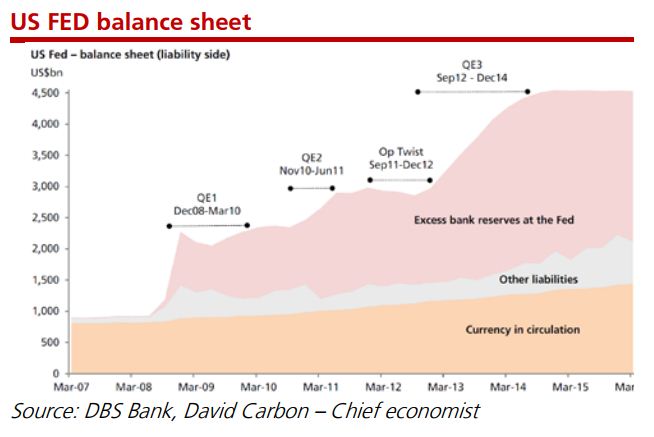
The United States' Federal Reserve will declare the decision to unwind its balance sheet at the September FOMC meeting, followed by an implementation from November or December, reported DBS Group Research.
While the QE injections added up to over USD 3.6 billion posts the global financial crisis and the genuine effect on treasury yields and liquidity withdrawal from the economy are substantially lesser than what the figure proposes. Initially, most investigations have put the effect of QE on 10-year treasury yields (at present at 2.3 percent) at any place between 20-40bps.
Besides, approximately 90 percent of the USD 3.6 billion of QE money went straight into the FED's cellar in the form of excess reserves held by banks instead of being "infused" into the economy. So the FED purchased USD 3.6 trillion worth of bonds (and other longer-term resources) and paid for them with short-term stores at the FED itself.
Economists' at DBS research think that as QE did little good and little harm on the way in, it should be equally benign on the way out. He has also lowered his FED funds rate forecast with just another one hike in December this year (down from two hikes) following by four hikes in 2018.
Although this write-up is about August, we look further ahead at several important events in September that may result in a jittery equity market this month. Investors could capitalize on the latest rally to pare down equity exposure ahead of these developments. The first is a confluence of central banks’ policy meetings – the FED, ECB, and the BOJ. We expect the FED to hold rates steady at the 19-20 September FOMC meeting but may announce the commencement of its balance sheet reduction. In Europe, the ECB is expected to make a decision on whether to extend or wind-down asset purchases in 2018 at its policy meeting on 7 September, DBS noted.
Meanwhile, FxWirePro launches Absolute Return Managed Program. For more details, visit http://www.fxwirepro.com/invest







