


 UBS Projects Mixed Market Outlook for 2025 Amid Trump Policy Uncertainty
  Trump Demands Powell Resign Over Fed Renovation Cost Overruns
  Strategy’s STRC Nears $100, Raising Prospects for Major Bitcoin Buys
  RBI Rate Hike Bets Surge as Inflation Rises
  Cardano Price Surges 10% as ADA Targets $0.30
  Fed Unveils Stablecoin Rules Under GENIUS Act
  Bitcoin Bull Cycle Still Early as XRP, NEAR Consolidate
  UBS Predicts Potential Fed Rate Cut Amid Strong US Economic Data
  Peter Brandt Flags Key XRP Breakout at $1.6572
  Indonesia Surprises Markets with Interest Rate Cut Amid Currency Pressure
  Moody's Upgrades Argentina's Credit Rating Amid Economic Reforms
  U.S. Treasury Yields Expected to Decline Amid Cooling Economic Pressures
  Evernorth XRPN Nasdaq Listing Delayed to October 12
  U.S. Government Moves Over $100M in Bitcoin and BNB


 Add as a preferred source on Google
On Wednesday, the new trade negotiations will begin between the US and China and the annual economic conference in Jackson Hole organised by the Kansas Fed will also begin on this Thursday. Both events mark the two factors that currently drive USD exchange rates: the US government’s trade policy and the Fed’s monetary policy.
While in the recent past, Bank of Japan (BoJ) confirmed rumors and tweaked by announcing a shift to the range of assets it would buy as form of its yield curve control strategy and introducing extensive "forward guidance" committing to low rates for a prolonged period of time. It would now allow larger volatility of the 10y yield around its 0% target, while it still plans to counteract excessively rapid increases in the yields. However, the market reaction to last week’s media reports probably showed the central bankers that this adjustment left alone would result in an appreciation of the yen.
USDJPY tend to plunge during summer vacation season ("Obon" in Japanese language which is in mid-August). Such seasonality is not strong, but USDJPY showed tendency to decline for the first 10 days of August. Especially in the past 5 years since Abenomics started, the pair dropped during the first 10 days of August four times out of five.
Off spot reference: 110.61, buy a 1M 111.1151 /109 put spread indicatively (vols 7.4/7.6 vs 8.05 choice).
The maximum payout is 115bp, max payout/cost ratio is 3.2, and the put spread is 53% discounted to a standalone 1M 110.25 USD put/JPY call.
The rationale for the put spread structure is two-fold:
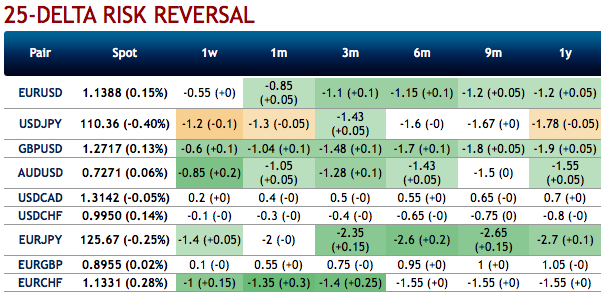
a) It takes advantage of the recent widening of short-dated risk reversals in favor of JPY calls to reasonably stretched levels adjusted for the level of ATM vol.
USDJPY 1M 25D risk-reversals currently imply a spot-vol correlation level of around -38%, which is not a historically high bar for realized spot-vol correlation to beat but is nonetheless expensive vis-à-vis recent delivered numbers (2-wk +25%, 1-mo +10%) and supportive of skew selling option structures such as put spreads; and
b) The extent of any potential yen strength from here is likely to be capped in the fundamental view, specifically after the knee-jerk decline in USDJPY spot late last week. Courtesy: JPM
Currency Strength Index: FxWirePro's hourly JPY spot index is flashing at 27 levels (which is mildly bullish), while hourly USD spot index was at -27 (mildly bearish) while articulating at (07:55 GMT). For more details on the index, please refer below weblink:







