


 XRP Price Drops 3% Despite Ripple-Backed Evernorth Nasdaq Debut
  Solana Alpenglow Upgrade Set for October 21: What It Means for SOL
  UBS Predicts Potential Fed Rate Cut Amid Strong US Economic Data
  U.S. Stocks vs. Bonds: Are Diverging Valuations Signaling a Shift?
  Ripple-Backed Evernorth Set for Nasdaq Debut With 473 Million XRP
  Moody's Upgrades Argentina's Credit Rating Amid Economic Reforms
  Cardano Price Drops 15% as Whales Sell 110 Million ADA
  China’s Growth Faces Structural Challenges Amid Doubts Over Data
  Pi Network Price Eyes $0.10 Ahead of Protocol 28 Upgrade
  Mexico's Undervalued Equity Market Offers Long-Term Investment Potential
  Ripple Mints 19.6 Million RLUSD Amid Banking Expansion
  Global Markets React to Strong U.S. Jobs Data and Rising Yields
  Moldova Criticizes Russia Amid Transdniestria Energy Crisis
  US Gas Market Poised for Supercycle: Bernstein Analysts
  Stock Futures Dip as Investors Await Key Payrolls Data
  Trump’s "Shock and Awe" Agenda: Executive Orders from Day One
  U.S. Treasury Yields Expected to Decline Amid Cooling Economic Pressures


 Add as a preferred source on Google
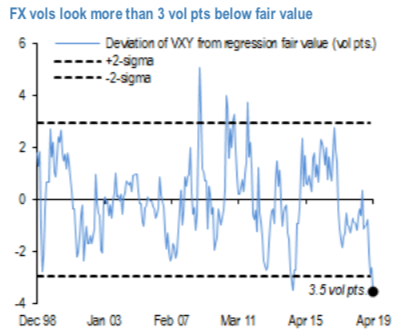
The FX volatility is very low and turnover suggests that participation is also declining. This is highlighted by the tight ranges in FX despite substantial reversals in both equities and debt markets. We reckon the stasis in the FX market is symptomatic of a market approaching a pivot point.
Dual changes are likely, the first one is that the dollar, which has been the dominant driver could be giving way to risk appetite again, as the market throws in the towel on its weaker USD views yet again. With risk appetite in other markets ‘euphoric’, this tilt could well drive a substantial rise in FX volatility.
The latter potential change is that the FX market may drift away from trading in a top-down fashion. As divergences appear between both the outlook for growth in economies and the reaction function of central banks, we think a bottom-up approach to the market could become the path to success.
As the bearish trend in FX volatilities continues, the appeal of buying optionality at low entry levels clashes with the negative time decay options suffer when catalysts for higher realized vols are missing.
We try to shed some light on the perennial debate between tactical vs strategic vol investment approaches by updating a systematic FX short-vol trading model introduced in March. As we write, the model would largely keep the short-vol bias.
Despite the rebound as occurred during the last week of April, FX vols remain near historical lows. Current volatility levels appear more than 2 std.devtn. undervalued based on the J.P. Morgan cyclical fair value for FX vols (refer above chart). In this market characterized by ultra-depressed volatility levels, the strategic appeal of holding long-optionality positions clashes with the multi-month trend dragging vols even lower, thus impacting long positions via time decay.
In the first part of this note, we update a systematic FX short-vol model as released earlier this year, for shedding some light on the perennial debate between tactical vs strategic approaches when managing vol trades.
Also, it appears natural to look for possible catalysts towards higher FX vol levels by investigating relationships involving other asset classes, as done for instance in the J.P. Morgan View, the rolling bear market in volatility. In the second part of the note, we focus on the possible relationship between FX and rates vols. Courtesy: ANZ & JPM
Currency Strength Index: FxWirePro's hourly EUR spot index is inching towards 77 levels (which is bullish), USD is at -8 (neutral), while articulating (at 08:23 GMT).
For more details on the index, please refer below weblink: http://www.fxwirepro.com/currencyindex







