


 Bitcoin Price Falls Below $83K as Liquidations Hit $697M
  RBI Raises Repo Rate to 5.50% in Hawkish Shift on Inflation Risks
  Fed Unveils Stablecoin Rules Under GENIUS Act
  Fed’s Hammack Says Bond Yield Surge Is Not Driven by Inflation Fears
  Kalshi Withdraws PEPE Perpetual Futures Filing
  Kazakhstan and Tether Explore Tenge Stablecoin and RWA Tokenization
  Fed Unveils Stablecoin Rules Under GENIUS Act
  RBA Says ASX Still Falls Short on Governance and Risk Controls
  ECB May Stop Rate Hikes After December, Capital Economics Says
  Sector Spotlight: Data Availability and Storage Lead 24-Hour Market Gains
  Cardano Price Surges 10% as ADA Targets $0.30
  U.S. Government Moves Over $100M in Bitcoin and BNB
  BlackRock’s Rick Rieder Favors Bonds Over Stocks as Treasury Yields Surge
  Bitcoin Bull Cycle Still Early as XRP, NEAR Consolidate
  Cardano Price Eyes $0.30 as ADA Whale Activity Surges


 Add as a preferred source on Google
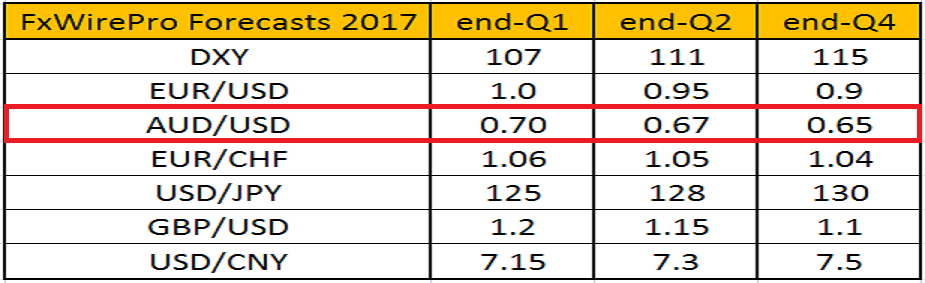
In 2016 the Australian dollar (AUD) has benefited from the recovery in commodity prices, but lost grounds at the end of the year to post U.S. Presidential election rally in U.S. Dollar. We expect this to continue even in 2017 following the Federal Reserve’s optimism on three interest rate hikes and President Donald Trump’s fiscal policies.
Thereby, we foresee that the AUD/USD to hit lowest since March 2009 by the end of the fourth quarter and trade at around 0.65.
However, the fundamentals supporting Australian dollar are favourable in 2017, keeping economic growth well above 2.5 percent mark. Also, recovery in commodity prices including energy post-OPEC deal will lend further support to the growth trajectory. Interestingly, the Australian economy will remain sensitive to the Chinese grounds as it is the largest export markets for the Aussies, which accounts 32 percent of total exports.
The easier monetary policy has helped to bolster country’s demand, as the Reserve Bank of Australia reacted to sub-target inflation by cutting the official rate by 50 basis points during the last year to 1.50 percent. Additionally, the RBA’s policy stance in 2017 will completely depend on the developments in consumer inflation and in the event that the Australian dollar appreciates.
Moreover, it is worth noting that the heavy sell-off in Australian dollar (AUD) is mainly because of Donald Trump’s fiscal spending appeal, which is expected to be financed from government borrowing and not because of growth in U.S. economy.
If Trump successfully implements his fiscal plan, consumer inflation will surely rise, giving the Federal Reserve wider space for an interest rate hike. Thereby, rising Fed fund rate will increase the cost of borrowing. After the Presidential election result, AUD witnessed a massive selling against U.S. dollar, sending the AUD lower by 8 percent to 0.715 in just a month’s time.







