


 Zcash Mining Profits Surge as Liquidity Risks Grow
  Fed’s Logan Signals 50 Basis Points More in Rate Hikes
  Australia Consumer Confidence Plunges as RBA Rate Hike Hits Households
  Ethereum Price Drops Below $2,600 as Long Liquidations Hit 4-Month High
  Bitmine to Stop Ethereum Buying After Reaching 5% ETH Supply
  Yen Sinks as BOJ Rate Hike Fails to Impress Markets
  RBI Uses $10 Billion Currency Swaps to Drain Excess Rupee Liquidity
  Fairshake Backs 32 Pro-Crypto House Candidates
  Sector Spotlight: Data Availability and Storage Lead 24-Hour Market Gains
  Strategy’s STRC Nears $100, Raising Prospects for Major Bitcoin Buys
  Evernorth XRPN Nasdaq Listing Delayed to October 12
  Cardano Price Surges 10% as ADA Targets $0.30


 Add as a preferred source on Google
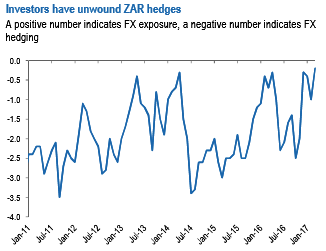
In BRICS FX bloc, ZAR weakness has probably run its course while the RUB benefited from the improving macro story in Russia and, more recently, from the firm recovery in oil prices with Brent bouncing above $55.
We expect USDZAR to settle around 13.5-14.00 in the days ahead as a base-case scenario. An overshoot is easily possible as investors have been increasing OWs and cutting FX hedges in recent weeks (refer above diagram).
We think a downgrade of local-currency ratings to junk is unlikely in the coming quarters. However, risks are that local-currency assets will not have much buffer against any policy deterioration going into 2018.
The HUF suffered the most in CEEMEA space, as the market discounted the sharply dovish stance of the MNB, which may use FX swap auctions to fine-tune liquidity and drive the currency lower.
In LatAm, the CLP strengthened the most, as other currencies remained pretty stable this week. The TWD and PHP took the lead in East Asia, benefiting from better US/China relations, Trump being vocal about the dollar being excessively strong, and boosted by a World Bank report raising the local forecast growth profile.
In Mexico, we still favor calendar skews and hold to our short-term view that more attractive carry-to-volatility ratios could drive speculative positioning to further correct, with USDMXN likely converging to the 18.2-18.6 range, all else equal.
We remain wary of both NAFTA negotiations and domestic political risk in H2’17, so we recommend positioning for near-term performance in MXN followed by a weaker H2 via 1m vanilla options. Next week, the Trump-Xi meeting could cast light of US trade strategy going forward, and could reverberate on USDMXN.







