


 Sector Spotlight: Data Availability and Storage Lead 24-Hour Market Gains
  Strategy’s STRC Nears $100, Raising Prospects for Major Bitcoin Buys
  Australia Consumer Confidence Plunges as RBA Rate Hike Hits Households
  Solana User Growth Jumps 33%, Outpacing Ethereum and Chainlink
  Jay Clayton Named Trump’s AI Czar as XRP Past Resurfaces
  Kalshi Withdraws PEPE Perpetual Futures Filing
  Fed Minutes Signal Another Rate Hike by Year-End
  Trump Demands Powell Resign Over Fed Renovation Cost Overruns
  China Shuts 670 Banks as Bitcoin Eyes Financial Risks
  BlackRock’s Rick Rieder Favors Bonds Over Stocks as Treasury Yields Surge
  DogecoinVM Makes DOGE Transactions 300x Faster
  Yen Sinks as BOJ Rate Hike Fails to Impress Markets


 Add as a preferred source on Google
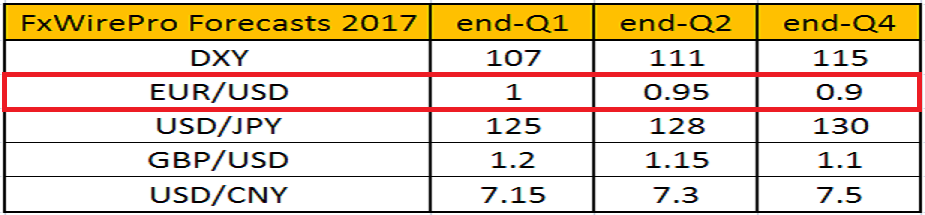
The Eurozone economy is expected to maintain a moderate rate of economic growth going into 2017, undershooting the European Central Bank’s (ECB) objective. This will likely keep the central bank in a dovish state, although no change in monetary policy is expected through entire 2017, with the deposit rate remaining steady at -0.40 percent and the repo rate at zero percent.
We foresee that the EUR/USD to hit parity by the end of the first quarter and trade at around 0.90 by end 2017, before plunging to its record low of 0.82 towards the first half of 2018.
Moreover, it is worth noting that the heavy sell-off in Euro (EUR) is mainly because of Donald Trump’s fiscal spending appeal, which is expected to be financed from government borrowing and not because of growth in U.S. economy.
If Trump successfully implements his fiscal plan, consumer inflation will surely rise, giving the Federal Reserve wider space for an interest rate hike. Thereby, rising Fed fund rate will increase the cost of borrowing. After the Presidential election result, EUR witnessed a massive selling against U.S. dollar, sending the Euro lower by 9 percent to 1.0398 in just a month’s time.
There seems to exist a number of political flashpoints in the upcoming year; Netherlands is scheduled to hold its general elections in March 2017 where the nationalist/populist-right-wing Freedom party led by Geert Wilders, is leading in the polls. This will be followed by the general elections in France, scheduled for May. Heading to Italy, the populist Five-Star Movement is neck-to-neck with the Democratic Party.
Despite possible uncertainties, we do not expect any major exit to happen in the euro economy; however, risks of such an ambiguous economy into the new year will definitely weigh on the common currency.







