


 Indonesia Surprises Markets with Interest Rate Cut Amid Currency Pressure
  Wall Street Analysts Weigh in on Latest NFP Data
  Bank of America Posts Strong Q4 2024 Results, Shares Rise
  BOJ Raises Interest Rate to 31-Year High as Yen Weakens
  Zcash Privacy Demand Rises as AI Exposes Bitcoin Transactions
  Fed’s Williams Signals One More Rate Hike Before Year-End
  Gold Prices Fall Amid Rate Jitters; Copper Steady as China Stimulus Eyed
  China Shuts 670 Banks as Bitcoin Eyes Financial Risks
  Fairshake Backs 32 Pro-Crypto House Candidates
  Bitcoin Bull Cycle Still Early as XRP, NEAR Consolidate
  U.S. Government Moves Over $100M in Bitcoin and BNB
  Gold Prices Slide as Rate Cut Prospects Diminish; Copper Gains on China Stimulus Hopes
  Yen Sinks as BOJ Rate Hike Fails to Impress Markets
  Geopolitical Shocks That Could Reshape Financial Markets in 2025


 Add as a preferred source on Google
The RBA’s monetary policy statement hasn’t been a material change, but a possible point of difference may be around the currency given that the AUD TWI has fallen back to near 2017 lows.
In Europe, the focus would continue to be on political developments in Spain. On the data front, after an uneventful start to the week for euro area economic data, Tuesday would bring in October's retail sales figures.
Following significant downside surprises in the German and French spending data published last week, euro area retail sales are expected to have fallen more than ½% MoM at the start of Q4, having risen a solid 0.6% QoQ in Q3. In addition, the final services and composite PMIs for November are also due tomorrow - tallying with other recent economic surveys, the flash euro area composite PMI leapt a larger-than-expected 1.5pts in November to 57.5, the highest since April 2011 and a level arguably consistent with an acceleration in GDP growth in the current quarter from 0.6% QoQ in Q3, we expect to see a contrasting picture between rising euro-area services PMIs.
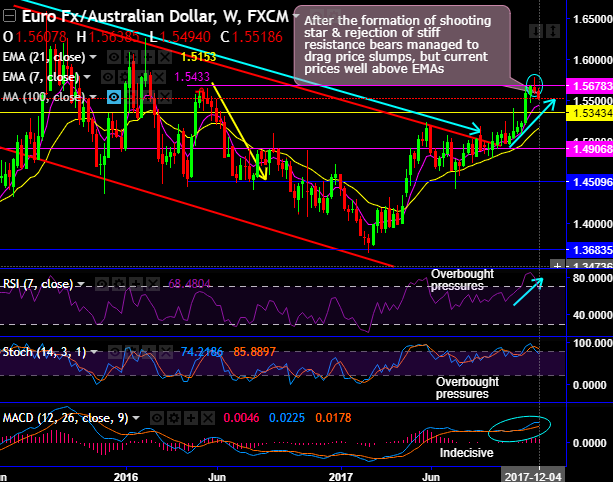
Meanwhile, the EUR uptrend remains intact but with hiccups in the minor trend, but a deeper setback into 1.5678 can’t be excluded as long as key-resistance between 1.5662 and 1.5678 is capping the upside.
The bearish forecast reflected the view that the ECB would be quieter on taper in the near-term. Moreover, markets appeared better prepared for an ECB taper than for the onset of Fed balance sheet normalization, as reflected by already-long EUR positions and overshooting valuations vs. rates, so any rise in yields was expected to be led by the US.
On the other hand, AUD, by contrast, is likely to be weighed down, firstly by its stand-out sensitivity to China sentiment (underlying economic linkages and Australia’s status as a liquid proxy for China), and secondly by the downside risks to RBA policy in Q4’17, including from a housing market that’s not liking its macro-prudential medicine.
OTC Outlook and Options Strategy: In the case of optionality, the skews of 2m implied volatilities are projected to spike above the current realized (refer above nutshell), positively skewed IVs indicate bidding for hedging upside risks in underlying spot.
Technically, the risk is essentially pricing in the bearish case in the minor trend but the major uptrend remains intact, as it is linked to the possibility of volatile Aussie spikes. We articulate the euro’s technical trend against Aussie dollar in our recent post (refer the same in our technical analysis section).
Thus, contemplating all the above underlying factors of EURAUD, we like being short vol in short run, selling that premium conditionally on a pay-off benefiting from a lower spot.
Prefer a ladder to a call spread ratio As we expect limited spot appreciation and topside volatility, we recommend buying a 2m call ladder. Buy 1 ITM Call of 2m tenor, simultaneously stay short in 1m 1 ATM Call and Sell 1 OTM Call of positive thetas (strikes 1.5153/spot/1.5678).
That structure improves the odds compared to a call spread ratio as the maximum and constant profit zone is reached over a range instead of a single spot level.







