


 Navigating the Crypto Pulse: Weekly Market Resilience and Institutional Inflows
  Ripple-Backed Evernorth Set for Nasdaq Debut With 473 Million XRP
  Cardano Hits Five-Year Transaction Record as ADA Price Falls
  Wall Street Analysts Weigh in on Latest NFP Data
  U.S. Banks Report Strong Q4 Profits Amid Investment Banking Surge
  Most Americans Oppose Election Betting on Prediction Markets, Poll Finds
  Ripple Mints 19.6 Million RLUSD Amid Banking Expansion
  Oil Prices Dip Slightly Amid Focus on Russian Sanctions and U.S. Inflation Data
  Global Markets React to Strong U.S. Jobs Data and Rising Yields
  Bitcoin Price Faces Volatility Ahead of US CPI and Fed Speech
  Moody's Upgrades Argentina's Credit Rating Amid Economic Reforms
  Hyperliquid (HYPE) Price Analysis: Can Bulls Push Above $88?
  Energy Sector Outlook 2025: AI's Role and Market Dynamics
  XRP Ledger Foundation Confirms 100B Supply Safe After Security Fix
  Dogecoin Price Rebounds as DOGE Defends $0.08 Support
  U.S. Treasury Yields Expected to Decline Amid Cooling Economic Pressures


 Add as a preferred source on Google
The Turkish lira rallied strongly in the past two sessions as media speculation mounted that CBT will finalise $20bn of swap lines from the BoJ and BoE. Such swap lines make a secondary story. They would not have really turned around the lira’s prospects in an adverse fundamental environment, even if the Fed and ECB had joined with the other two (they have not).
Nevertheless, right now the signs are positive for a quick rebound of Turkish exports as the EU is preparing to return to activity. An expectation of stronger export numbers immediately, we think, will dispel the lira’s current woes, although many problems will remain in the longer-term.
We have been UW in the GBI-EM Model portfolio since April 2nd. This reflects our view that currencies with large external debt repayment needs as well as countries that rely on tourism are likely to underperform. Overall, the BoP dynamic will be crucial for lira's performance, in our view.
The current account recorded a likely temporary $4.9bn deficit in March. On a seasonally adjusted basis this was worth about $3.9bn and in annualized terms 6.6% of GDP. There is very likely a strong temporary component to this result, with earlier lockdowns in Europe affecting exports before measures in Turkey constrained domestic demand. For the year, our economist expects close to a flat position on the current account, but there are large uncertainties in the current environment.
Hedging Strategy:
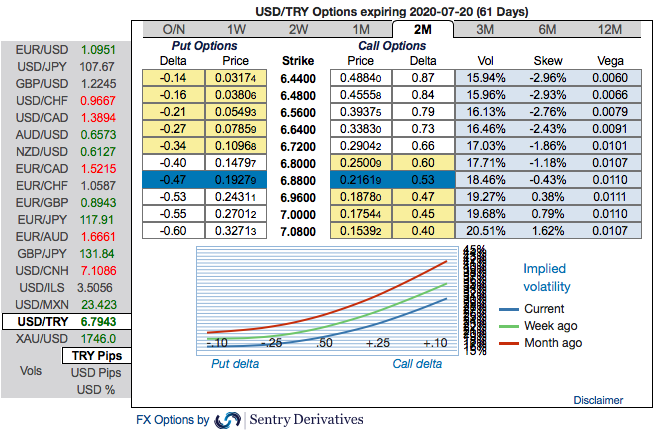
On hedging grounds, capitalizing on prevailing price dips and above driving forces, we already advocated 2m USDTRY debit call spreads with a view to arresting momentary downside risks and upside risks in the major trend. At spot reference: 6.7940 level, initiated 2m 6.25/7.20 call spreads at net debit. One can achieve hedging objective as the deep in the money call option with a very strong delta will move in tandem with the underlying spikes.
It seems that hedgers of TRY are positioned for the upside risks on the above fundamental factors. The skewness 2m IVs are indicating upside risks, higher bids for OTM calls are hedging bias towards upside risks (refer above nutshell).
IVs of this underlying pair is also on the higher side, trending highest among the G20 FX space. Call options with a higher IVs cost more, because, increasing IV is conducive for the option holder, just for an intuition that the higher likelihood of the market ‘swinging’ in holder’s favour. Courtesy: Sentry, JPM & Commerzbank







