


 Cardano Price Struggles as NIGHT Token Surges 20%
  Midnight NIGHT Token Surges 86% as Smart Contract Launch Nears
  XRP Ledger Hits 10 Million AI Payments as Bitcoin Retreats
  XRP Rises as Evernorth Merger Vote Clears Key Nasdaq Hurdle
  Goldman Sachs Names CATL, Zenergy Top China Battery Picks
  NEAR Intents Hack Drains $3.8 Million, NEAR Price Falls 7.5%
  Michael Saylor Sees Strategy, Strive Expanding Bitcoin Credit Market
  MSTR Stock Rises 3% as Strategy Challenges MSCI Bitcoin Stance
  Citi Raises Bitcoin Target to $113,000 as Crypto Outlook Improves
  AAVE, PUMP, WLD and SKY Rally as Crypto Market Slips
  Ripple Locks 700 Million XRP Back in Escrow After October Release
  Bitcoin Exchange Reserves Hit Multi-Year Low at 2.68 Million BTC
  Chainalysis AI Traces $387M Bitget Hack in Under 10 Minutes
  Citi Raises Bitcoin Price Target to $113,000 on ETF Optimism
  Zcash Awards $8 Million in Grants After Orchard Bug Crisis
  XRP Asia Launches to Accelerate XRPL Adoption Across Asian Banks


 Add as a preferred source on Google
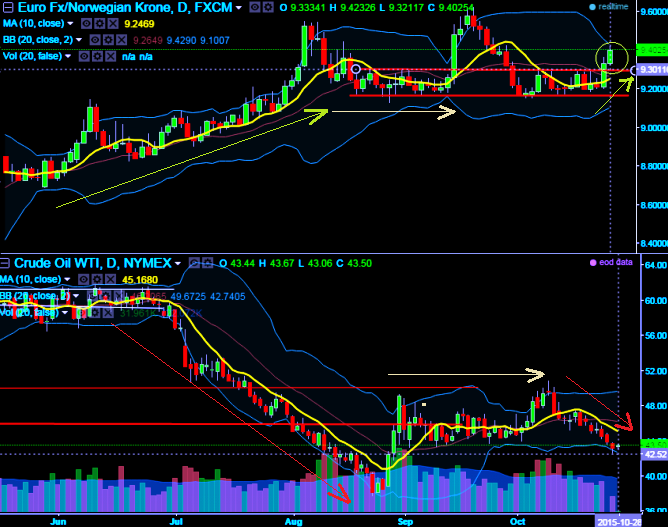
Last week EIA reported crude oil inventory at 8.0M which was a rise from previous 7.6M, as a result crude prices began dropping which in turn led to NOK's losses. This depreciation in NOK in H2 2014 has underpinned inflation, but slower growth and lower domestic demand will drag prices lower once the FX effect starts to wane.
While oil prices will dictate the short term moves in NOK, the longer term NOK outlook will depend on the lasting effects of lower oil prices to domestic drivers.
Providing support to domestic growth though is Norway's fiscal rule and the translational effect of a weaker NOK on Norway's sovereign oil fund, GPFG, that act as an automatic stabilizer.
We can observe from the diagram how this currency cross is directly proportional to the oil prices.
NOK weakened sharply as crude oil benchmarks pushed to significant new lows today, while EURNOK managed to clear the 9.30 resistance, shifting the focus back higher.
NOK hit by renewed crude oil selloff, EURNOK clears 9.30 resistances.
This FX translational effect would have increased the government's fiscal scope by NOK 30bn in 2014, i.e., about 1% of mainland GDP-sums which the government can use to prop up the economy.
As such, we are cautiously constructive on NOK and believe EUR/NOK can drift lower once oil prices are able to find a stable floor.
Hence, only a material recovery in oil prices is likely to stop those cutting rates to new historic lows.
While this risk overhangs, we maintain a negative stance on the currency, with EUR/NOK expected to retest the recent highs around 9.60.

- News

- Economy

- Central Banks
- Investing
- Research
- Roundups
- Digital Currency
- Insights
- Technical Analysis
- Technology
- Business
- Law
- Health
- Nature
- Fintech
- Science
- Topic
- Opinions
- ©Econometrics LLC . All Rights Reserved.
FxWirePro: NOK likely to extend losses on the back crude supply glut – EUR/NOK heading towards H2 targets at 9.60
Wednesday, October 28, 2015 11:33 AM UTC
Editor's Picks



- Market Data
Most Popular




