
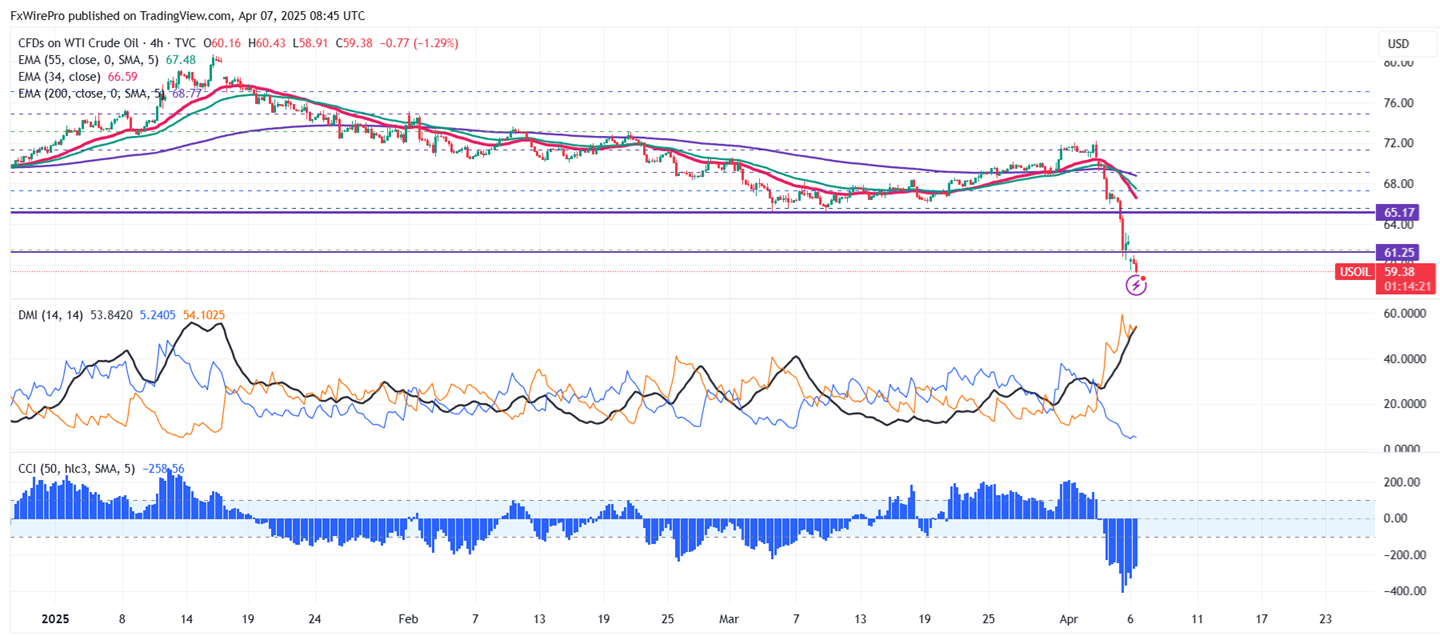
Crude oil prices declined sharply due to global recession concerns. It hits a low of $58.91 yesterday and currently trading around $59.85.
The recent drop in crude oil prices can primarily be attributed to economic volatility brought about by President Donald Trump's threat of extra tariffs, which has fueled the specter of a near future global trade war that will be succeeded by an economic downturn. This has brought about diminishing demand for oil, and U.S. West Texas Intermediate (WTI) crude dipped below $60 a barrel and Brent crude dipped to around $63.48 a barrel.
And further pressure on oil prices comes from OPEC+'s cutting 411,000 barrels a day of oil production, an action which exceeded expectations in the market and brought extra downward pressure. Together, all these—tariffs, more production, increased trade tensions, including China's reaction to American tariffs—have led to rising market volatility and expectation of an imminent global recession, and that is making investors sell oil futures
Price Resistance and Support Levels
The near-term resistance is around $61; any breach above this level could push prices higher to $62.10/$63.20/$64/$65. On the downside, immediate support is at $58.50 violation below targets $57.28/$56.31/$55.
It is good to sell on rallies around $61 with a stop-loss aof round $63.20 and a target price of $55.


