


 China’s Growth Faces Structural Challenges Amid Doubts Over Data
  UNCX Network Hack Drains $86K From Ethereum Token Pool
  Dogecoin Price Rebounds as DOGE Defends $0.08 Support
  Cardano Price Drops 15% as Whales Sell 110 Million ADA
  Gold Prices Fall Amid Rate Jitters; Copper Steady as China Stimulus Eyed
  Oil Prices Dip Slightly Amid Focus on Russian Sanctions and U.S. Inflation Data
  U.S. Banks Report Strong Q4 Profits Amid Investment Banking Surge
  Ripple-Backed Evernorth Set for Nasdaq Debut With 473 Million XRP
  Bitcoin Price Drops as US Dollar Hits 18-Month High
  Ethereum Whale Moves $15.95M ETH to Kraken After Nine Years
  2025 Market Outlook: Key January Events to Watch
  Urban studies: Doing research when every city is different
  Ripple Mints 19.6 Million RLUSD Amid Banking Expansion
  Trump’s "Shock and Awe" Agenda: Executive Orders from Day One
  DeFi Development Adds 22,070 SOL to Solana Treasury
  Moldova Criticizes Russia Amid Transdniestria Energy Crisis


 Add as a preferred source on Google
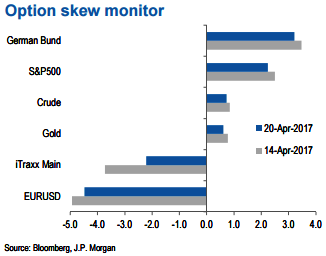
The skewness is the difference between the implied volatility of out-of-the-money (OTM) call options and put options. A positive skew implies more demand for calls than puts and a negative skew, higher demand for puts than calls. It can, therefore, be seen as an indicator of risk perception in that a highly negative skew in equities is indicative of a bearish view.
The above chart demonstrates z-score of the skew, i.e. the skew minus a rolling 2-year Avg skew divided by a rolling two-year standard deviation of the skew.
A negative skew on iTraxx Main means investors favor buying protection, i.e. a short risk position. A positive skew for the Bund reflects a long duration view, also a short risk position.
Net spec positions are the number of long contracts minus the number of short using CFTC futures only data. This net position is then converted to a USD amount by multiplying by the contract size and then the corresponding futures price.
To proxy for speculative investors, for commodity positions, we use the managed money category, for equity positions we use Leveraged funds and Asset managers (see above chart), whereas other assets use the legacy non-commercial category.
We then scale the net positions by open interest. The chart shows the z-score of these net positions, i.e. the current net position divided by the open interest, minus the average over the whole sample divided by the standard deviation of the weekly positions over the whole sample.
US rates is a duration-weighted composite of the individual UST series excluding the Eurodollar contract. UK ICE Brent positions are with one week lag. The sample starts on the 13th of June 2006.
Risky versus safe haven currencies: Difference between net spec positions on risky & safe currencies Net spec position is calculated in USD across 5 "risky" and 3 "safe" currencies (safe currencies also include Gold).
These positions are then scaled by open interest and we take an average of "risky" and "safe" assets to create two series. The chart is then simply the difference between the "risky" and "safe" series.
The final series shown in the chart below is demeaned using data since 2006. The risky currencies are AUD, NZD, CAD, RUB, MXN, and BRL. The safe currencies are JPY, CHF, and Gold.







