


 Bitcoin Bull Cycle Still Early as XRP, NEAR Consolidate
  Sector Spotlight: Data Availability and Storage Lead 24-Hour Market Gains
  Fed Unveils Stablecoin Rules Under GENIUS Act
  Fed Unveils Stablecoin Rules Under GENIUS Act
  Evernorth XRPN Nasdaq Listing Delayed to October 12
  RBA Set for September Rate Hike as Inflation Stays High
  Yen in Focus as BOJ, Fed Rate Hikes Reshape Currency Markets
  JPMorgan CEO Jamie Dimon Warns Mythos AI Raises Cyber Risk Tenfold
  U.S. Government Moves Over $100M in Bitcoin and BNB
  China Shuts 670 Banks as Bitcoin Eyes Financial Risks


 Add as a preferred source on Google
On the macro side, with the chorus of hawkish commentary by the Fed officials, the market has priced in a March hike immediately. Given that, widening U.S.-Japan yield spreads have brought USDJPY higher and the pair is now reaching the upper end of its trading range since mid-January. We now expect the Fed to deliver three hikes in this year (Mar, Jun, and Sep vs. May and Sep previously).
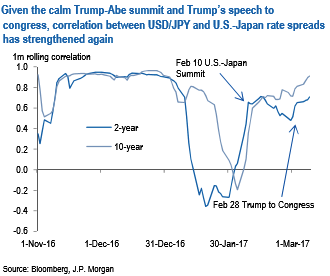
One important assumption of our bearishness on USDJPY is that a correlation between the pair and U.S.-Japan yield spread collapses with heightening concerns on political risks. Although it was the case early this year, the correlation has strengthened again as the U.S.-Japan summit and Trump’s speech to Congress passed without any troubles (refer above chart).
As a more harmonic U.S.-Japan relationship and a more aggressive Fed stance would mitigate downside risks to USDJPY to some extent, we revised USDJPY forecasts for end-June, end-September, and end-year to 111, 108 and 105 from 105, 102 and 99 respectively. We target 105 at end-March next year.
As the new profile suggests, however, we think factors mentioned above would not be influential enough to get USDJPY on a solid upward path heading to 120 or even higher, and still, expect it to track a modest downward trend in the medium-term.







