


 Gold Prices Slide as Rate Cut Prospects Diminish; Copper Gains on China Stimulus Hopes
  Fed’s Hammack Says More Data Needed Before Next Rate Move
  Fed Unveils Stablecoin Rules Under GENIUS Act
  Bitcoin Nears $87K as Crypto Market Gains
  Wall Street Analysts Weigh in on Latest NFP Data
  S&P 500 Relies on Tech for Growth in Q4 2024, Says Barclays
  OKXICE Files for 24/7 Tokenized US Stock Trading
  U.S. Government Moves Over $100M in Bitcoin and BNB
  Trump Demands Powell Resign Over Fed Renovation Cost Overruns
  China's Refining Industry Faces Major Shakeup Amid Challenges
  Global Markets React to Strong U.S. Jobs Data and Rising Yields
  BOJ Set for 25-Basis-Point Rate Hike as Yen Weakness Fuels Inflation
  Goldman Predicts 50% Odds of 10% U.S. Tariff on Copper by Q1 Close
  RBA Set for September Rate Hike as Inflation Stays High
  Fed Unveils Stablecoin Rules Under GENIUS Act


 Add as a preferred source on Google
The US 10Y Treasury yield slipped from its four-year high of 3.03% to 2.98%, with most of the move occurring before the ECB decision. 2Y yields nudged higher, from 2.47% to 2.49%, to help flatten the curve. Fed fund futures yields continued to price the next rate hike in June as a 100% chance.
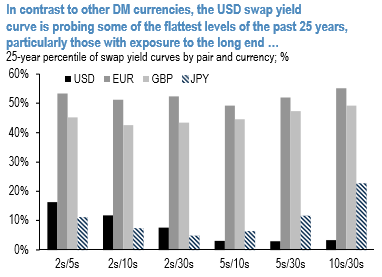
Despite new multi-year highs in Treasury yields for some sectors, focus in U.S. rates markets was squarely on the curve and going forward, the swap yield curve slope is increasingly exposed to more idiosyncratic factors via the term structure of swap spreads.
Though the recent re-pricing of the yield curve has not been particularly disorderly, its proximity to inversion has generated significant focus. This is certainly not unique to the U.S., but is more pronounced relative to other currencies (refer above chart). That is not to say flat curves are unprecedented, particularly if one adopts a global perspective. Starting with a simple historical comparison, the 2s/10s USD swap curve, for example, has been inverted for nearly 6% of the past 25 years while in GBP this was true nearly one-quarter of the time over the same period.
A key risk factor to our stance is the potential role of exotics hedging flows. Because certain types of payoffs — e.g., non-inversion and other range accrual notes — contain embedded binary optionality, rapid changes in the convexity profile of these exposures can lead to very disorderly rebalancing flows as dealers manage their exposure.
This has been an important consideration in the past for U.S. rates. That said, the stock of such exposures in USD notes is considerably smaller than was the case in 2006, reflecting a more narrow set of both investors and issuers, and the leverage of those exposures is much lesser as well.
These flows also only tend to arrive in force when the curve is meaningfully inverted, rather than right around zero.
Therefore, while potentially a driver of the swap yield curve for short periods of time, we expect neither a large nor a sustained impact on the swaps curve from exotics-related hedging. Courtesy: JPM
FxWirePro launches Absolute Return Managed Program. For more details, visit:







