


 Global Central Banks Brace for More Rate Hikes as Inflation Risks Rise
  BOJ Flags Import Costs and Yen Shocks as Persistent Inflation Risks
  BOJ Set for 25-Basis-Point Rate Hike as Yen Weakness Fuels Inflation
  Yen Extends Gains as BOJ Rate Hike Bets Rise
  RBA Says ASX Still Falls Short on Governance and Risk Controls


 Add as a preferred source on Google
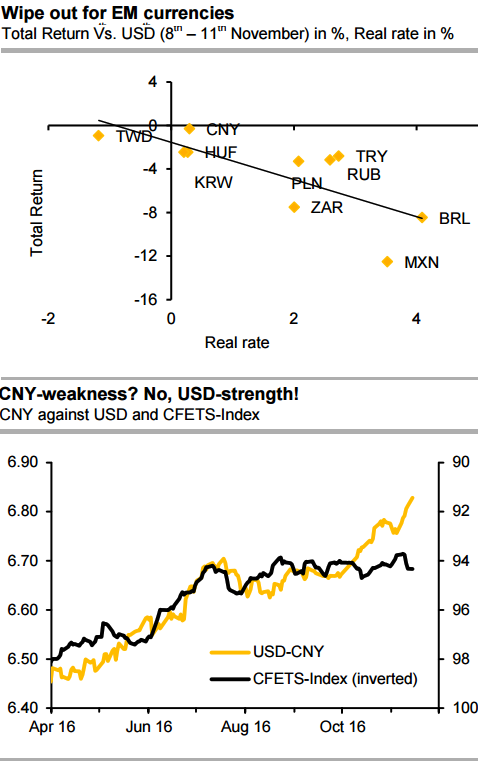
USDCNY reaches new highs on a daily basis, spiking higher at 6.8428 levels. The exchange rate is back on levels last seen in 2008.
A collapse of the Chinese currency one may think. But this interpretation is incorrect.
Instead, the USDCNY exchange rate is the expression of the rigorous implementation of the policy the Chinese authorities have been pursuing since spring: they are stabilizing the exchange rate of the renminbi against the CFETS currency basket.
Since August the renminbi has been very stable in this sense. In the days since the US election it has even appreciated a little.
But as the US dollar continues to appreciate against the other currencies in the world that means: USDCNY has to fully reflect the general USD strength so as to keep the exchange rate towards the currency basket stable.
Admittedly the PBoC is likely to be trying extremely hard to prevent the CNY from depreciating. In particular, the balance of payment data continues to illustrate a dramatic outflow of reserves (which, for some reason, is in stark contrast to the data published by the PBoC).
But we have to admit one thing: so far it has been successful. The development in USDCNY should not disguise that.
In the meantime, CNY has weakened somewhat against the basket of currencies, overall, it’s a 7.4% USDCNY rise in a year, an 8.4% rise in EURCNY and a 23% fall in CNYJPY. Further depreciation is likely in the months to come, hence, it is recommended to buy either 4M USDCNY forwards of January expiries or deploy debit call spreads eyeing on above mentioned forecasts of USDCNY.
Those who are suspecting the following USD softness due to the US Fed has changed the stance for hiking funds rate and to defer until beginning 2017, we understand that there is little-implied volatility in the OTM strikes which is why it is advisable to choose longs in 4M (1.5%) ITM strikes in the debit call spreads, while shorting 2M (1.5%) OTM strikes.







