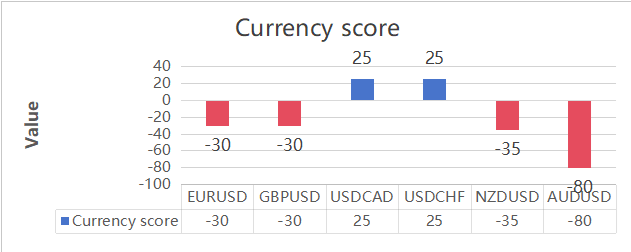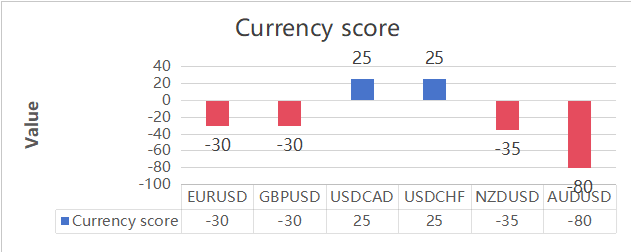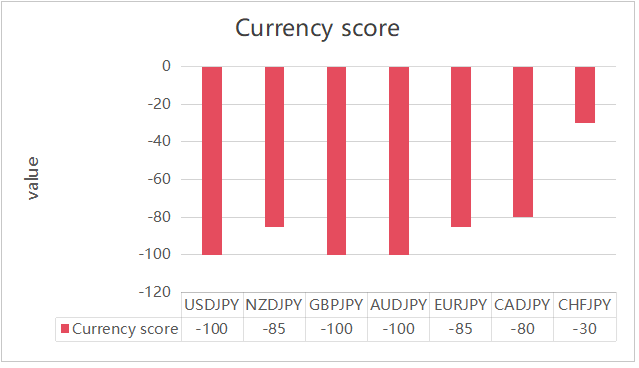
The pair pared some of its gains as demand for safe-haven assets increased. Overall bias remains bullish as long as support 0.8780 holds. It hits a low of 0.88422 and is currently trading around 0.88492.
The Swiss franc (CHF) has become stronger recently as a safe investment because of rising tensions between Russia and Ukraine. Investors are moving their money into the CHF due to its reliability and Switzerland's stable economy. The demand for the CHF has increased, reflected in its rising value against other currencies. Switzerland's political neutrality and economic strength reinforce the attractiveness of the CHF during times of uncertainty.
The U.S. Personal Consumption Expenditures (PCE) data for October 2024 showed that the PCE price index rose by 2.3% year-on-year, up from 2.1% in September, indicating a slight increase in inflation. The core PCE index, which excludes food and energy, climbed by 2.8%. Both personal income and spending increased, primarily driven by services such as health care and housing, while spending on goods declined. These inflation figures suggest that the Federal Reserve may reconsider interest rates since inflation continues to exceed their 2% target.
Technical Analysis
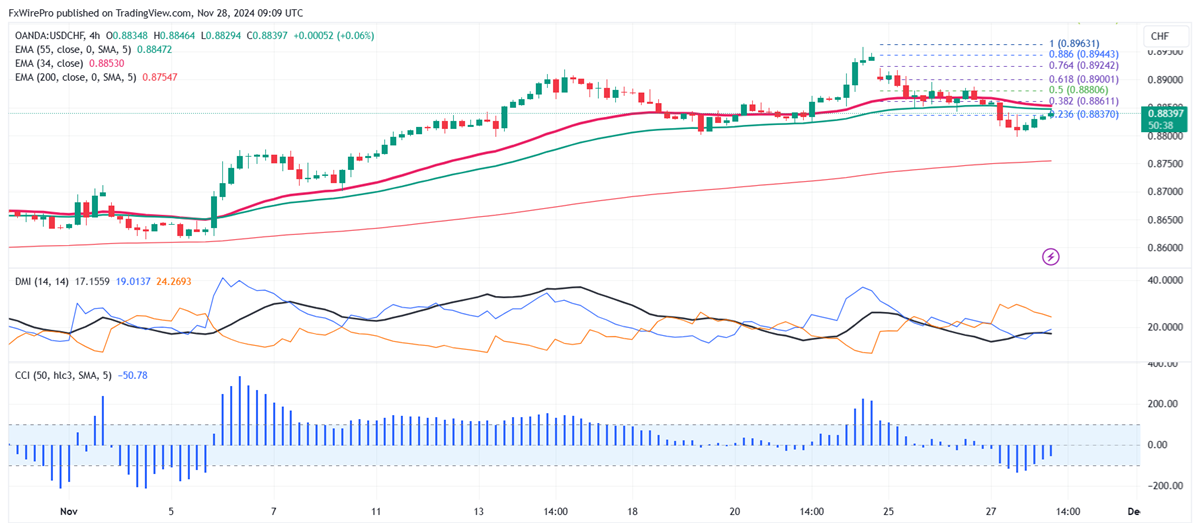
The pair is currently trading below the 34- and above 55-EMA on the 4-hour chart.
Near-Term Resistance: Current resistance is at 0.8840. A break above this level could lead to targets at0.8880/0.8900/0.8960/ 0.9000/0.90480.The break above 0.87500 confirms that decline from 0.9225 got completed at 0.83750.
Immediate Support: The next support level is at 0.8780. If this level is broken, the pair could drop to 0.8720/0.8700/0.8660/0.8600/0.8580, 0.8550, 0.8525, 0.8499, 0.8440, 0.8420, 0.8390, 0.8365 (61.8% Fibonacci projection), or even 0.8340.
Indicator Analysis (4-hour chart)
- CCI (50): Bearish
- Average Directional Movement Index: neutral
Overall, the trend remains mixed
Trading Recommendation
Consider buying on dips around 0.8800, with a stop loss set at 0.8770 and aiming for a target price of 0.9000.