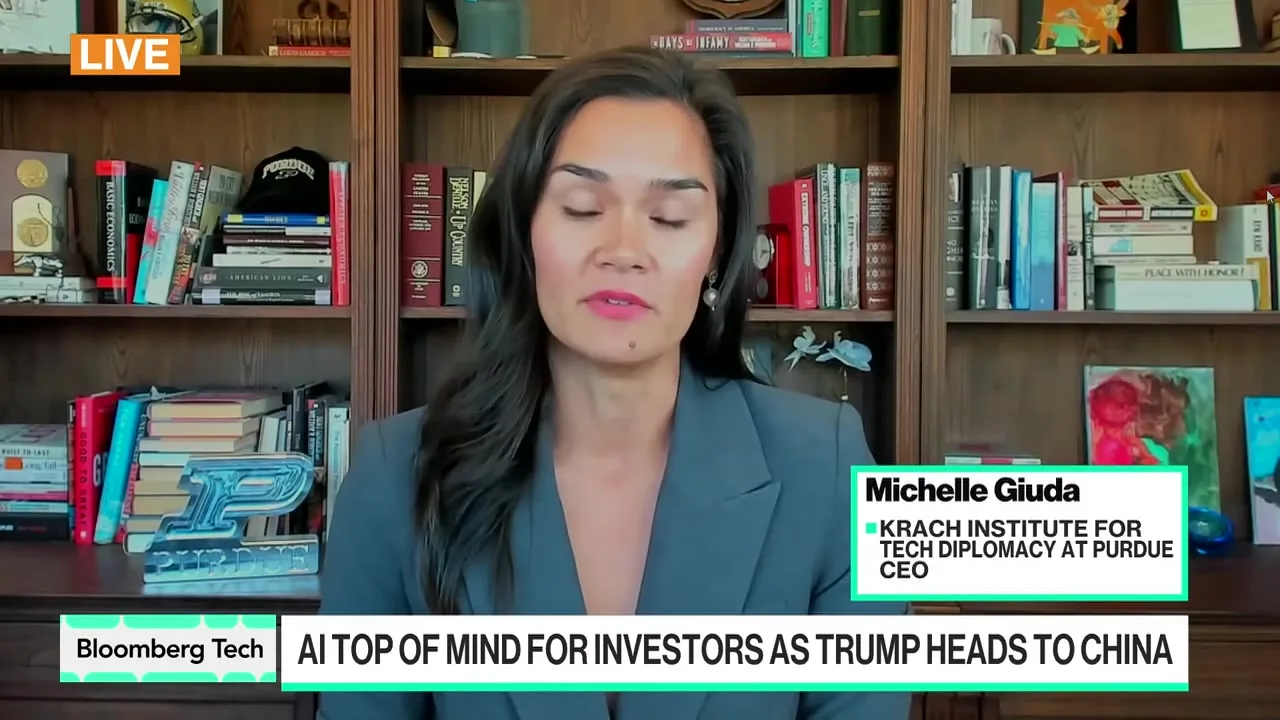
The United States should strengthen chip export controls and support Nvidia's future among five priorities for competing with China, Michelle Giuda, chief executive of Purdue's technology diplomacy institute, said.
Speaking on Bloomberg Technology on Nov. 16, Giuda said questions surrounding Nvidia would likely play a smaller role in President Donald Trump's meeting with Chinese President Xi Jinping than some expected. She put greater weight on the countries' longer-term competition over technology.
“In the long term here, chips and our leadership matter to America's future,” she said. “And in the long term, chaos and conflict here at home are only a benefit to China.”
Giuda's first priority was establishing what happened at Nvidia. Her second was supporting the company's long-term success because of its importance to American leadership in artificial intelligence.
She also called for every American board to have national security expertise, strong export controls and unquestioned American technology leadership. “So this moment then becomes a catalyst instead of a setback,” she said.
Giuda expected chips and restrictions on their export to feature prominently in the leaders' talks. She said China wanted advanced American chips and had expanded restrictions on rare earth exports to secure access to them.
She expected the meeting to focus on continuing a trade agreement under which the United States keeps tariffs low and China suspends its rare earth export restrictions. She described that arrangement as necessary in the short term.
Over the longer term, the United States needed to expand its ability to mine and process rare earths to reduce China's bargaining power, she said. She gave no timetable for building that capacity.
Giuda described the economic relationship as “status quo” and expected an “incremental grinding struggle” until the United States separated economically and technologically from China. She said America led in technology and artificial intelligence and needed to widen that gap.
She called for expanding the use of American chips and AI through advanced models and open-weight models, whose underlying parameters are available to users. The aim was to get the world using American technology faster than China could spread its own.
Asked about Elon Musk's expected participation in Trump's trip, Giuda said his work, including at SpaceX, made his involvement consequential. She expected him to have an important voice in discussions about strengthening American technological and economic leadership.
Giuda said maintaining the relationship would give American businesses time to strengthen supply chains and reduce dependence on China. She also called for more rare earth mining and processing and rebuilding industrial capacity.
She said meetings between the leaders, particularly in person, helped preserve that time. The United States needed to use it to strengthen its economic foundations and increase its bargaining power over the longer term.