
Artificial intelligence reached a new frontier last week, when an AI defeated human Go champion Lee Se Dol four games to one.
Google’s Alpha Go has made headlines for its ability to carry out the complex calculations involved in the ancient Chinese game, but I would like to give a different perspective. I want to talk about Go itself – an ancient game also known as baduk in Korean, weiqi in Chinese and Igo in Japanese - which ends, each time, with a beautiful representation of the player’s thoughts and strategies laid out across the board.
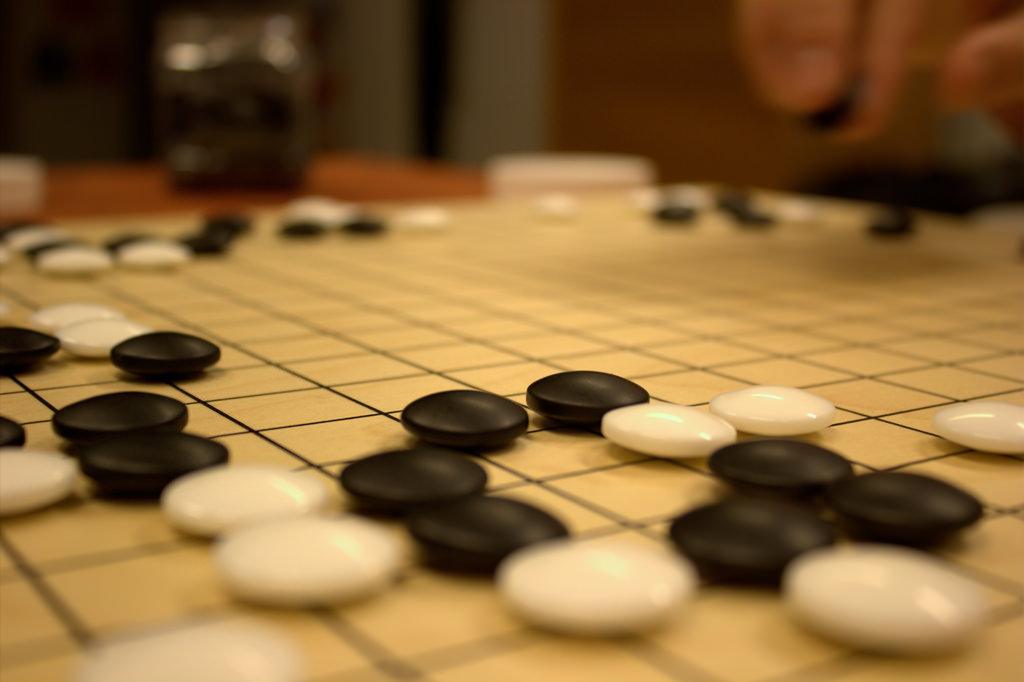
Go starts with an empty board of 19x19 squares. Two players take turns to place black or white stones anywhere on it, trying to surround a larger percentage of the board with their stones, or to limit the moves of the other player.
No stones are moved throughout the game, except when they are “captured,” by being surrounded. The aim of the game is to create spaces and connectedness. Go ends naturally, when both players agree there are no more useful moves to be made.

2benny/Flickr, CC BY
The point of the game is not destroy your opponent, but to win with a small margin of points. It’s said that if a player is losing by more than eight points, they should resign.
Still, Go has never been about winning. Rather, it is about being able to develop oneself and learn. Perhaps this is why Go only made it to the West recently and instead chess, a game which is essentially destructive, has gained much more attention.
Go is equitable and deeply strategic, because each stone is equally valuable. The only thing that distinguishes a stone is the way it is placed at any given time. All have the potential to change the game.
Go derives from the Japanese word Igo. Although the game originated in China somewhere between three and five thousand years ago, it became known as Go during the Edo period (16th-19th centuries), when Japan established highly regarded and competitive schools and academies.
Although Japan has attracted and fostered world Go champions, such as the legendary father of the 20th century game, Go Seigen, Go has flourished throughout Asia.
The ethics of Go are deeply embedded in the Taoist and Confucius philosophies of self-mastery and the connection between humans and the natural environment.
Natural objects, such as stones and mountains, are attributed rights to exist regardless of the value they bring to the human sphere. Thus each tree or stone is intrinsically valued.
The four directions of the world symbolise the four sides of the Go board. The number of cross points on the board are equivalent to the number of lunar days in a year and the star points represent the most advantageous points on the board (the Goban).

Star points marked out on a standard Go board. Rommel2 via Wikimedia Commons
Go has been used to inform strategic decisions in governance and business. On a personal note, I used weekly games of Go to provide a conceptual framework for my PhD, by using the philosophical terms of space, connectedness and territoriality to describe the outcomes of civic engagement of recent migrants in Western Australia. The game has a supreme ability to challenge one intellectually, whilst remaining playful.
The DeepMind challenge was not a competition, but a conversation between humans and non-humans. In the same way, Go is regarded as a conversation of hands.
When you ask for a game, you are asking “please teach me”. The player with opposite coloured stones is not only your opponent, but also your teacher and friend.
So let’s not forget in the debate about Google Artificial Intelligence that Go is foremost a game to be enjoyed. Much like life itself.
 Silvia Lozeva does not work for, consult, own shares in or receive funding from any company or organization that would benefit from this article, and has disclosed no relevant affiliations beyond the academic appointment above.
Silvia Lozeva, Researcher and Lecturer , Curtin University
This article was originally published on The Conversation. Read the original article.


