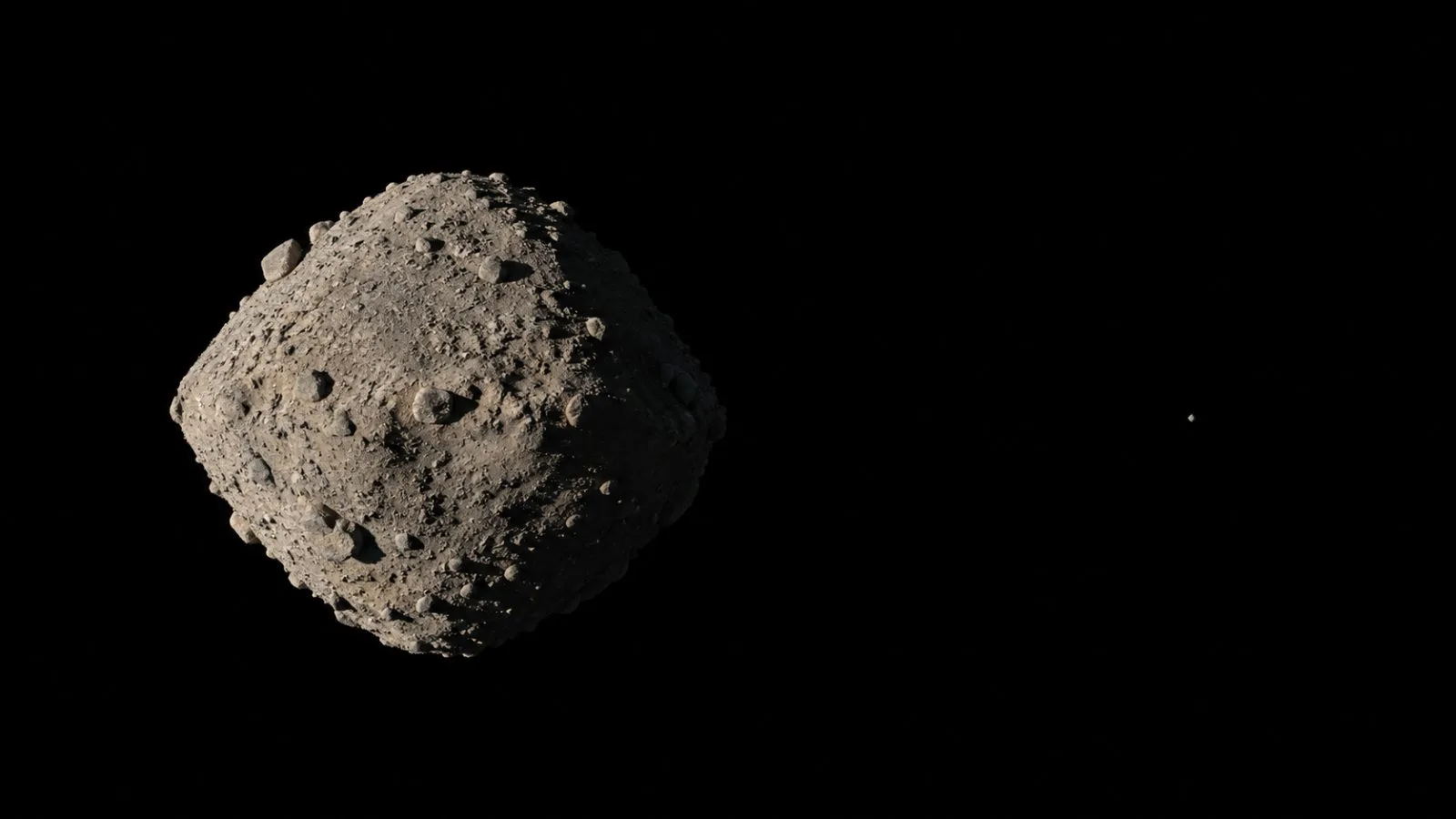
Hera’s braking maneuvers brought it to within 1,280 kilometers of the Didymos system, where its camera captured the asteroids as separate objects for the first time.
Hera recorded the scene with its monochromatic Asteroid Framing Camera on Oct. 18, the European Space Agency (ESA) said. Dimorphos spans only about one pixel in the frame, but it is distinguishable from the larger Didymos. The pair are about 197 million kilometers from Earth.
ESA measures Didymos at 780 meters in diameter and Dimorphos at 151 meters across. The asteroids orbit at an average separation of 1.15 kilometers, while Dimorphos moves around Didymos at about 18 centimeters per second. Together, they form the binary asteroid system Hera was sent to study.
Two braking burns, spaced one week apart earlier this month, reduced Hera’s speed relative to the asteroids to 20 meters per second, ESA said. The maneuvers put the spacecraft on a controlled approach for its closer survey.
NASA’s Double Asteroid Redirection Test (DART) spacecraft hit Dimorphos on Sept. 26, 2022, at 6.1 kilometers per second. ESA describes the collision as a planetary defense experiment testing whether a kinetic impact can change an asteroid’s path. The strike sent debris across 10,000 kilometers of space and shortened Dimorphos’ orbit by about 33 minutes, according to ESA. The agency says Dimorphos is the first solar system object whose orbit humans have measurably changed.
ESA says the deflection exceeded impact simulations, leaving questions about how the collision changed Dimorphos and which of its properties explain the result. Hera will examine whether the impact left a crater or altered the asteroid’s shape, as well as its makeup, structure and mass. Two CubeSats will join Hera’s instruments in examining the impact area. ESA plans to release the first detailed images of Dimorphos on Nov. 25.