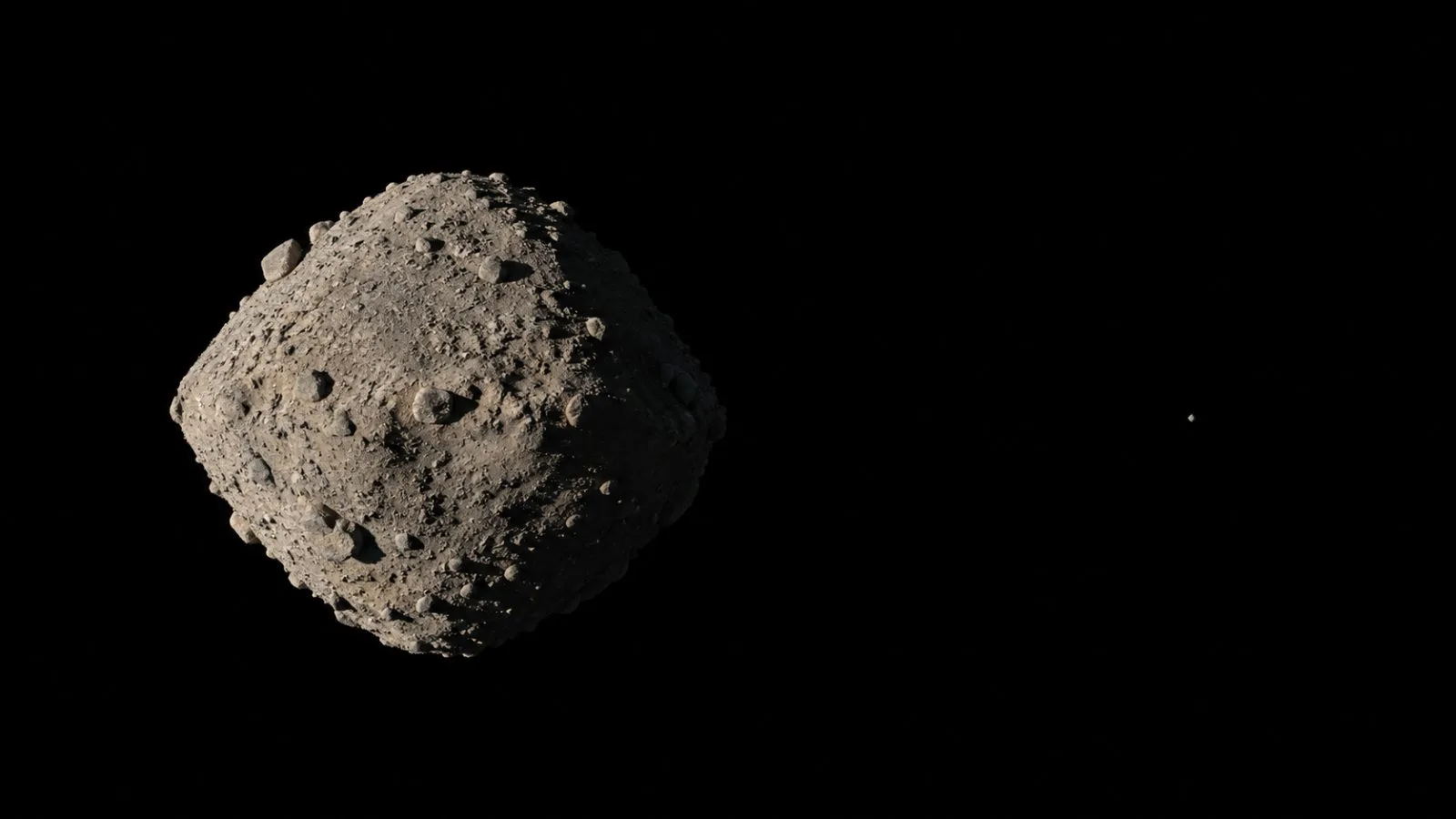
Europe’s Hera spacecraft has begun surveying the Didymos asteroid system, gathering measurements to help scientists assess how NASA’s 2022 DART test altered Dimorphos’ orbit.
The European Space Agency (ESA) said Nov. 11 that Hera is surveying the pair from about 25 to 30 kilometers away. The initial phase is set to measure the bodies’ mass and shape, as well as their orbital dynamics and rotational properties, according to the Hera-Japan operations plan. EconoTimes had previously reported Hera’s expected November arrival in its earlier coverage of the mission.
Dimorphos spans 151 meters and circles Didymos, which is 780 meters in diameter, ESA said. NASA’s Double Asteroid Redirection Test (DART) struck Dimorphos on Sept. 26, 2022. ESA says the collision shortened Dimorphos’ orbit around Didymos by about 33 minutes, with an uncertainty of plus or minus one minute.
A 2026 study published in Science Advances found another effect: DART shortened the pair’s roughly 2.1-year orbit around the Sun by 150 ± 20 milliseconds. ESA has described DART’s impact as the first measurable human-caused change to an object in the solar system, referring to the change in Dimorphos’ orbit around Didymos.
Hera is intended to document the impact’s effects and help establish kinetic impact as a well-understood planetary-defense method, ESA says. Hera mission scientist Michael Kueppers said the current survey aims to produce “big-picture findings” relevant to those goals. He has also said impact models predicted several possible asteroid responses, and Hera’s observations will show which, if any, matched what happened.
The Hera-Japan plan schedules the Detailed Characterization Phase to begin Dec. 2, 2026 (JST), with Hera operating 8 to 20 kilometers from the asteroids. A close-observation phase focused on the impact crater is scheduled to start Feb. 3, 2027 (JST). Before those phases, ESA plans to unveil detailed images of both asteroids on Nov. 25.