Whether it’s to reset our mental health or simply to take time out from the hurly-burly of work and urban life, many of us head for oceans and rivers to enjoy their restorative capacities.
Encountering wild animals in these blue spaces contributes to the beneficial effects of being in nature and forms the basis of tourist economies the world over.
Yet, how does our presence affect the creatures that call blue spaces home, and how do encounters with wild species change our relationships with natural environments?
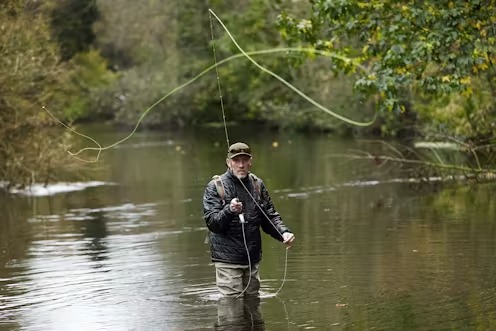
For nearly a decade, we have been researching human interactions with wild trout and salmon in the context of fly fishing. We spent months immersed in river environments both in the UK (the Lyd and Tamar in Devon, and the Usk and Wye in Wales) and North America (the rivers of the Gaspe region, Quebec and Lewisburg, Pennsylvania). We went fishing, observed and interviewed fly fishers, and learned as much as we could about fish behaviour.
In our recent paper, we explain how human interactions with fish can result in three kinds of interspecies encounters that strengthen people’s connections with wildlife and natural environments.
Separated encounters
Most often, wild animals remain indifferent to humans, driven as they are by natural motivations to feed and breed, within environmental habitats that humans do not fully understand.
For instance, Duane, a novice fly fisher we interviewed in Pennsylvania, didn’t know that trout eat aquatic insects: “I didn’t know squat … flies actually come out of the water?”
This lack of understanding of other species often ensures that wild animals remain undisturbed by human presence. Yet the elusiveness of creatures such as trout and salmon can also motivate people to find out more about them.
Slippery encounters
To improve their chances of catching fish, fly fishers learn about fish behaviour, river environments and the life cycles of the insects that fish feed on.
Equipped with this knowledge, fly fishers become better able to locate trout and salmon, and to select and cast a near weightless imitation “fly” designed to mimic a fish’s insect food.
Learning and honing these skills is a lifelong project during which fly fishers become savvy hunters with heightened abilities to sense what is going on in the water. Equally, fish learn too, becoming shy and ready to slip away from human contact.
Sticky encounters
On the rare occasions that fish are hooked, humans and fish enter what we call a “sticky encounter”. The mixed emotions of catching a wild salmon are captured in Annetta’s field notes:
I look down at this beautiful, majestic being. The fish is a fresh, healthy, silver, bright female … I look at her, she looks back at me … She wrangles free. She’s on a mission to spawn in her home river. I stand up but I’m weak in the knees. Full of pride, humility, and guilt.
Over time, these intense experiences of eye-to-eye contact can inspire fly fishers to consider the welfare of fish.
Fly fishers now release the majority of the fish they catch. Moreover, one fly fisher we interviewed explained that he has entirely removed the hooks from his flies, declaring: “I don’t want to catch that fish. I caught so many in my life. I know what the feeling is like.”
Stewarding blue spaces
It may seem ironic that fly fishers become passionate about conserving fish and river environments by practising what many people consider to be a cruel sport. Yet, fly fishers have first-hand experience of declining fish numbers.
Some of our interviewees spoke of trout and salmon as “canaries in the coal mine” – a warning sign of how river ecosystems are threatened by pollution, overdevelopment and climate change. In response, organisations such as the Wild Trout Trust and the Atlantic Salmon Trust highlight the necessity for conservation.
With wild populations of animals declining globally, the presence of humans in blue spaces deserves scrutiny. Nevertheless, interspecies encounters can change the relationship between people, fish and rivers from one of human gratification to one of reciprocity, stewardship and care.