


 RFK Jr. Launches Nationwide Vaccine Safety Review
  US Pressures Allies to Distance From Anti-Disinformation Conference
  Houthis Warn Saudi Airports After Deadly Riyadh Attack
  Pentagon Orders Iran Strike Preparations as Trump Weighs Military Action
  Hegseth Praises USS Abraham Lincoln Crew After Record Iran War Deployment
  JD Vance Questions Pentagon Plan to Livestream Fort Hood Shooter’s Execution
  Zelenskiy Slams US Over Deadly Russian Strikes on Ukraine
  Yandex Data Center Hit by Drone Strike as Russia-Ukraine Cyber Infrastructure Attacks Escalate
  Trump Buys Up to $25M in Meta Stock, Invests in SpaceX Debt
  US, EU Push for Action Against Asia’s Excess Factory Capacity
  US Suspends Microsoft, Adobe From Green Card Program
  Zelenskiy Offers Russia Energy Truce Amid Trump Pressure
  Trump Rallies in Texas as Republicans Face Tight Midterm Races
  Zelenskiy Criticizes US as Russian Strikes Kill 78 in Ukraine
  Berlin Coalition Talks Advance After Left Party Antisemitism Deal
  EU Rejects Italy, Greece Calls for Fiscal Rule Flexibility


 Add as a preferred source on Google
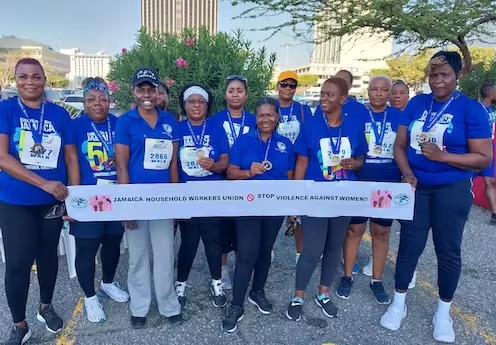

In thousands of households across Jamaica, domestic workers do the work of cooking, cleaning, gardening and caring for children, the elderly and people with disabilities.
While this work is essential to the functioning of the economy and to the well-being of many Jamaican families, domestic workers often experience low pay, poor working conditions and informal work arrangements. Due to their isolation in the home, they’re also vulnerable to sexual harassment and abuse.
In 2016, Jamaica ratified International Labour Organization Convention No. 189, the Domestic Workers Convention. The landmark convention is the first international legal instrument to recognize domestic work as equivalent to all other kinds of work and is founded on “the fundamental premise that domestic workers are neither ‘servants’ nor ‘members of the family’ nor second-class workers.”
Jamaica is one of only 36 countries to have ratified the convention. To its credit, the Jamaican government has made progress toward making decent work a reality for domestic workers, including by raising the national minimum wage.
Decent work deficits persist
A study I conducted with Lauren Marsh, of the Hugh Shearer Labour Studies Institute at the University of the West Indies, has been published to coincide with the seventh anniversary of Jamaica’s ratification of the convention. It finds that domestic workers continue to experience deficits in decent work.
Without government action, we fear that progress toward achieving decent work for this marginalized, but essential, workforce will stall.
We surveyed more than 200 domestic workers, held focus groups and interviewed key stakeholders in government and civil society.
Overall, we found that while domestic workers are generally covered under Jamaica’s labour laws, many experience an “enforcement gap” — the difference between the rights and protections established in law and those that are actually respected by employers in the workplace.
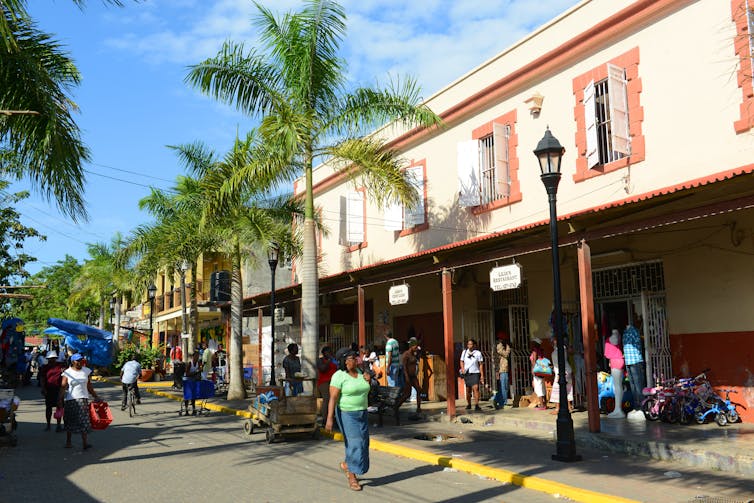
A woman shops in the historic downtown of Falmouth, Jamaica. (Shutterstock)
And while the Ministry of Labour and Social Security is sensitive to the challenges facing domestic workers, it currently lacks the capacity to adequately promote and enforce compliance with labour standards in the sector.
Furthermore, far too many domestic workers lack awareness of their rights. Just over half of survey respondents said they were not aware of any laws that protect domestic workers in Jamaica. This finding is troubling, as workers’ awareness of rights is key to their realization.
Domestic workers are generally frustrated with Jamaica’s slow pace toward making decent work a reality in the sector. For instance, nearly 90 per cent of domestic workers surveyed believe the government doesn’t adequately inform domestic workers of their rights; 82 per cent would like to see the government do a better job at enforcing laws that protect domestic workers.
Raising awareness
There is some good news. The Jamaica Household Workers’ Union, with 7,280 members across 13 chapters, has done excellent work in raising domestic workers’ awareness of their rights and protections.
We found that domestic workers who are members of the union are more likely than non-union domestic workers to contribute to Jamaica’s social security scheme, twice as likely than their non-union counterparts to possess a written employment contract, making enforcing rights easier, and are far more likely than their non-union counterparts to be aware of their labour and social security protections.
The Jamaica Household Workers’ Union is anticipating that the Sexual Harassment (Protection and Prevention) Act, 2021, which takes effect on July 3, will have a ripple effect of breaking the silence of domestic workers.
— Jamaica Gleaner (@JamaicaGleaner) June 26, 2023
Read more: https://t.co/iChYYLDEzJ #GLNRToday pic.twitter.com/RWJSTRS95K
These findings suggest that strengthening collective representation for domestic workers is a promising route to ensuring that rights on paper are rights in practice.
Our report includes several recommendations that may act as a guide to action for achieving decent work for domestic workers in Jamaica.
First and foremost, the Jamaican government must invest in building the capacity of the Ministry of Labour and Social Security to enforce and promote compliance with labour standards in the domestic work sector — including through the creation of a domestic work section — and through public awareness campaigns to ensure employers and workers alike know their rights and responsibilities.
Collective bargaining needed
To strengthen collective representation and worker voice, the government should also work with employers’ groups and the Jamaica Household Workers’ Union to establish the legal and institutional framework and conditions necessary for collective bargaining in the domestic work sector.
Decent work is fundamental to social justice, gender equality and fulfilling Jamaica’s commitments under the national development plan, Vision 2030 Jamaica.
Relative to its Caribbean neighbours, Jamaica is making slow but steady progress toward making decent work a reality for domestic workers — and the Jamaica Household Workers’ Union is establishing best practices in domestic worker organizing and collective representation.
That means Jamaica has the potential to become a regional leader in advancing decent work for domestic workers. It’s a leadership role the government and civil society should fully embrace.







