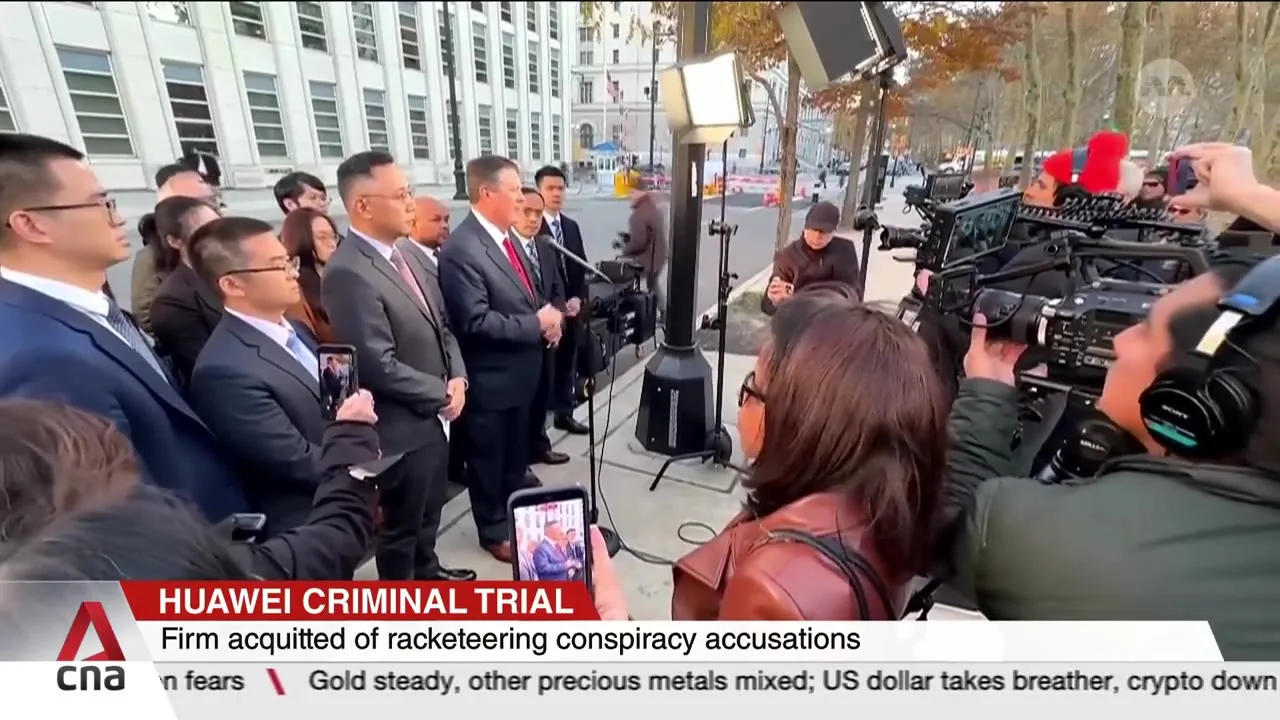
Huawei rejected a New York jury's verdict finding it guilty on 10 of 12 criminal counts, including trade secret theft and fraud, and said it would appeal, CNA reported on Nov. 25, 2026.
The jury acquitted the Chinese telecommunications equipment maker on two counts, including racketeering conspiracy, which carried the heaviest penalties. Huawei welcomed the acquittals.
The convictions included conspiracy to steal trade secrets, wire fraud, bank fraud, conspiracy to defraud and money laundering conspiracy.
Huawei said the verdict had “no legal or factual merit.” Sentencing was set for September 2027, and the company could face fines of billions of dollars if its appeal fails.
Prosecutors had argued that Huawei operated as a continuing criminal enterprise and that its leadership set the tone. Huawei's lawyers said prosecutors had selected isolated incidents to construct that account.
The case also concerned Huawei's business in Iran, which has faced US sanctions for years. Huawei conducted much of that business through a Hong Kong company called Skycom.
Huawei told banks that Skycom was a business partner, but prosecutors said it was a subsidiary. They argued that the distinction led banks to process transactions that violated US sanctions without knowing it.
Prosecutors also told the jury that Huawei technology helped Iran monitor and censor internet users and supplied cameras used to watch protesters.
China's foreign ministry said it opposed US efforts to suppress and contain Chinese companies. The case began in 2018, when a senior Huawei executive was arrested in Canada at the request of US authorities.
US officials have raised concerns that the Chinese government could use Huawei equipment for espionage. Huawei and Beijing have long denied those allegations.
Olivia Shen of the University of Sydney said the verdict reinforced decisions by countries including Australia and Canada to ban Huawei from their telecommunications networks.
“I don't know a single Australian policy maker that believes that was the wrong decision,” she said. Shen also said removing Huawei technology from existing systems was costly and complicated.
She said the bans affected Huawei's sales, but the company continued to sell equipment and mobile phones elsewhere. The outcome of Huawei's appeal and the size of any fine remain open.