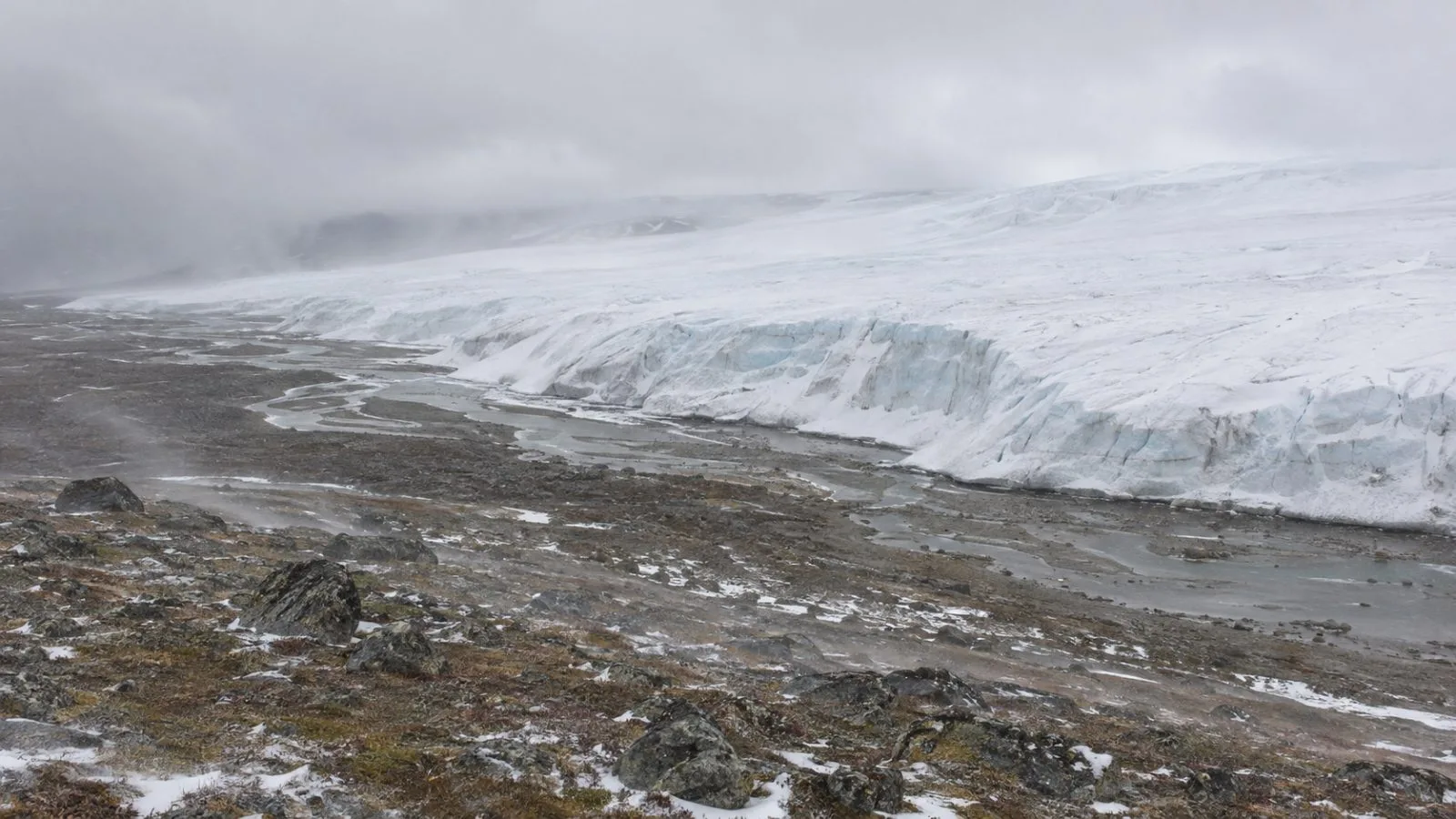
Human-caused summer warming halted a roughly 2,000-year advance of the Barnes Ice Cap on Canada’s Baffin Island around 1960, ending what a study defines as the opening stage of a glaciation.
The study appeared in Science on Oct. 22. The paper describes the Barnes cap as the last surviving portion of the Laurentide Ice Sheet, whose former reach included much of Canada and the northern United States. The study dates the cap’s smallest interglacial dimensions to the period after about 3,600 years ago. Growth resumed about 2,000 years ago, and the ice reached its maximum dimensions around 1960.
In the paper, “glaciation” refers to the first renewed ice growth, rather than a new continental ice sheet already taking shape. Columbia Climate School says earlier model-based work placed the next glaciation thousands or tens of thousands of years in the future. Its announcement says rebuilding the Laurentide Ice Sheet to its former scale would have taken about 30,000 years.
Researchers reconstructed the cap’s history using radiocarbon-dated vegetation preserved beneath the ice. Columbia Climate School says they also combined those findings with records from smaller ice caps in the region that had recently melted. The evidence allowed the team to trace the ice cap’s growth and subsequent retreat.
The study says human-caused summer warming shifted the cap to a negative mass balance after its peak, meaning it lost more ice than it gained, and its margin receded. The retreat took place even as summer sunlight reaching high northern latitudes continued to decline. The researchers identify greenhouse gas warming as a force counteracting that longer-term cooling trend.
Nicolás Young, a geochemist at Columbia University’s Lamont-Doherty Earth Observatory, called the finding “a very powerful example of how we have jolted the system.” Meredith Kelly, an earth sciences professor at Dartmouth, told WIRED that comparisons with other sites could help clarify the broader transition toward glaciation.